Digital marketer and founder of SuperBuzz Media, with hands-on experience in performance marketing, lead generation, WordPress, AI automation, and digital marketing tools. I share practical insights, real-world experiences, and tool reviews to help businesses make smarter digital decisions.
Disclosure: This post contains affiliate links. If you buy through them, we may earn a commission at no extra cost to you. We only recommend tools we use with our own clients.
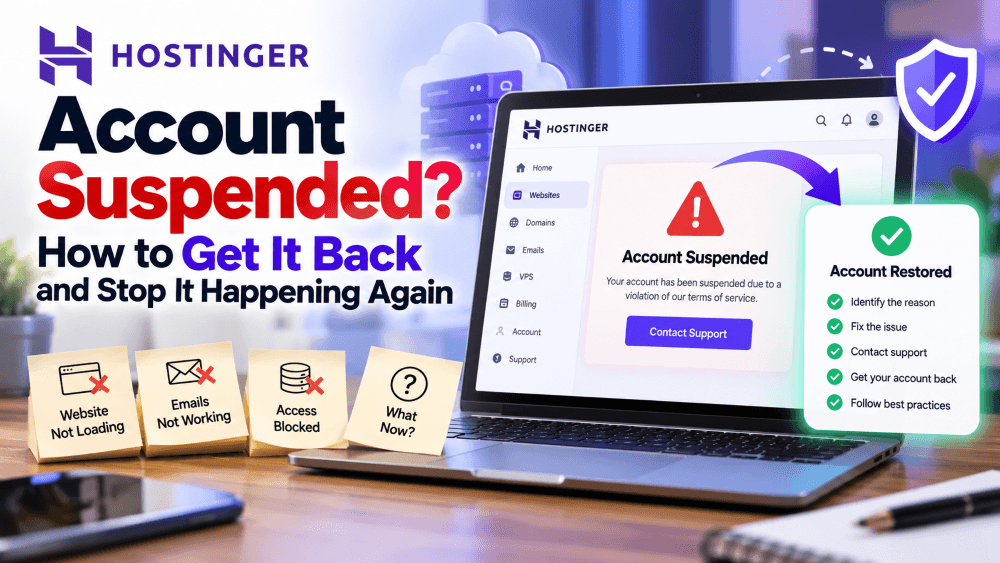
You open your website and it’s gone. hPanel won’t show your plan, or there’s an email asking for your ID within 7 days. If your Hostinger account has just been suspended or flagged for verification, this guide is for you.
Most suspensions can be reversed if you act quickly and send the right documents the first time. Below is exactly what triggers a suspension, what to do in the first hour, how to pass ID verification without endless back-and-forth, and how to make sure it never happens again.
Recent public reviews show a familiar pattern. A small business runs happily for months, then a verification email lands in a mailbox nobody checks. Seven days later the site, email and dashboard go down together, and the owner spends the next week sending the same documents to different support agents. Almost every step of that story is avoidable.
Hostinger suspends whole accounts, not just one site, when its automated systems or abuse team flag a risk. Knowing which trigger hit you tells you which fix to use.
Trigger
What it looks like
How common
Identity verification (KYC) not completed
Email asking you to verify ID within 7 days; whole account suspended if you miss it or fail
Very common in 2026 complaints
Phishing or malware report
Suspension email citing abuse; often a hacked WordPress plugin or theme planted the files
Common, and the most disputed
“High risk of misuse” flag
Account and sometimes your device blocked; asked to verify and appeal
Common for new accounts
Suspicious domain names
Generic finance or insurance domains flagged; asked for business proof matching the domain
Occasional
Terms of Service violation
Plan disappears from the dashboard homepage; warning on the Websites page
Catch-all
Domain-level hold (ICANN or registry)
Site and email stop; domain shows serverHold or pending verification
Separate from hosting, often confused with it
The phishing trigger deserves extra attention. Hostinger has a long history of being abused by scammers because it’s cheap and quick to sign up, so its abuse systems are aggressive. That means a legitimate site with one compromised plugin can get the same treatment as an actual scammer.
The new-account trigger is also real: payment from a card in a different name, a VPN at signup, or a cluster of new domains bought at once can all look risky to automated checks.
What to do in the first hour
Speed matters most here: KYC requests have a 7-day window, and abuse suspensions get harder to reverse the longer they sit unanswered.
Find the suspension email. Hostinger sends one email listing every suspended service, the reason, and the documents or actions it needs. Check spam, promotions and any old inbox tied to the account.
Confirm what’s actually suspended. In hPanel, go to Websites. A suspended plan won’t appear on the dashboard homepage and shows a warning there instead. If only your site or email is down, run your domain through a WHOIS lookup to rule out a domain-level hold.
Don’t open five tickets. Click Contact Us in the suspension warning on the Websites page and keep everything in one thread. Multiple tickets get routed to different agents and restart the clock.
If it’s a phishing or malware claim, ask for evidence. Request the exact URL or file path flagged. Then scan your site, remove the files, and update or delete outdated plugins and themes before you reply.
Secure everything. Change your hPanel, WordPress admin and FTP passwords and turn on two-factor authentication. If you were hacked, an unsuspended site will just get flagged again.
Save your data. Even when your account is suspended for a failed verification, Hostinger says you can still access backups and transfer domains. Download them now, whatever happens next.
Reply with everything at once. One complete, calm reply with all the documents gets resolved faster than a trickle of partial answers.
Getting through ID verification on the first try
Most “endless verification” stories come from one mismatch: the name on your ID, the payment and the account don’t line up. Fix that before you submit, not after a rejection.
Hostinger runs KYC on accounts its system marks as suspicious. You get an email with a secure link, upload your documents, and the check runs automatically. Miss the 7-day deadline or fail it and the whole account is suspended.
Have these ready before you click the link:
Government photo ID (Aadhaar, PAN, passport or driving licence) in the same name as the Hostinger account
Payment proof: the invoice from hPanel plus a bank or card statement line showing the Hostinger charge
Business proof if the account or domain is in a business name (GST certificate, Udyam registration or similar)
Access to the email address on the account, and an alternative email
Why verifications get rejected:
Problem
Fix
Card or UPI belongs to a family member or client
Add a short signed note explaining the relationship, plus their ID if they agree
Account name differs from ID (nickname, initials, business name)
Update the account name in hPanel to match your ID before submitting
Blurry photo, cropped corners, glare
Scan flat in good light; JPG, PNG or PDF, all four corners visible
Domain name doesn’t match your business
Show how they connect: a website, invoice or registration using the domain
Submitted from a VPN or different country
Turn off VPN and submit from your usual location and device
Only send what’s needed. Hostinger’s own guidance is to redact sensitive details that aren’t required, so mask full card numbers and unrelated statement lines.
Locked out of the account email? Use the Can’t Access Your Account? link on the login page. You’ll need an email you can access, a domain on the account, and an ownership document such as a payment receipt.
If support stalls
If you’ve sent complete documents and still get bot replies or new requests after 48 hours, escalate in writing and plan your exit in parallel.
Ask for a human and a ticket number. In live chat, ask directly to be passed to the abuse or verification team, and note the ticket ID.
Email the quality team. Hostinger publicly points unhappy customers to quality@hostinger.com. Send a short timeline: date suspended, what you submitted and when, and what you’re asking for.
Post a factual public review. Hostinger replies to most Trustpilot reviews, and that thread often reaches someone with more authority. Stick to dates and facts.
Request your data in writing. Ask explicitly for a full backup of files, databases and email, even if the suspension stands.
Ask about refunds the right way. Hostinger offers a 30-day money-back guarantee on most plans; suspensions for policy violations usually aren’t covered. If you’re inside 30 days and the suspension was an error, say so plainly.
Move the domain. If the domain is registered with Hostinger, unlock it and get the EPP code so you can point it at a new host.
Tip: Keep one running note with your timeline, ticket IDs and everything you’ve sent. Paste the same short summary at the top of every reply, so each new agent sees the full picture instead of asking you to start over.
How to make your account suspension-proof
You can’t control Hostinger’s abuse filters, but you can make sure a suspension never takes your data or your business down with it.
Keep off-site backups. Run a weekly backup to Google Drive or Dropbox with a plugin like UpdraftPlus. Hostinger’s backups sit inside the account that might get locked.
Don’t use a Hostinger mailbox as your login email. If that mailbox is suspended, you can’t receive reset or verification emails. Use Gmail or another outside address for the account.
Match names everywhere. Account holder, payment method and ID should be the same person or business from day one.
Verify early. Complete domain contact verification as soon as the email arrives; .in domains get only a 7-day window.
Patch WordPress weekly. Most phishing flags start with a hacked plugin. Delete what you don’t use, update the rest, and add a security plugin like Wordfence.
Avoid risky signup patterns. No VPN at checkout, and don’t buy a batch of generic finance or crypto domains on a brand-new account.
Keep your domain somewhere else. Registering it with a separate registrar means a hosting suspension can’t hold your domain hostage.
Our take as a web agency
At SuperBuzz Media we build sites for businesses across Chandigarh and Punjab, and the setup we recommend treats suspension risk as part of launch, not an afterthought: off-site backups, an outside login email and matching account details from day one.
Starting a new site? A fresh, verified account set up correctly from the start avoids most of the problems above.
Get Hostinger through our link and run through the prevention checklist as you set it up.
Need help getting a suspended site back online or migrating it safely? Contact SuperBuzz Media.
FAQ
How long does Hostinger ID verification take? Submission is automated, and the account updates on its own once you pass. You have 7 days from the request email to complete it.
Will I lose my website if my account is suspended? Not necessarily. For verification-related suspensions, Hostinger says you can still access backups and transfer domains. Download everything straight away.
Can I get a refund after a suspension? Refunds within 30 days are possible for genuine errors, but suspensions for Terms of Service violations are usually excluded.
My site wasn’t phishing. Why was I flagged? Usually a hacked plugin or theme placed phishing pages on your site without you knowing. Clean the site, then ask Hostinger for the flagged URL and request a review.
Is Hostinger still safe to use? For most small sites, yes: it holds strong overall ratings. Just follow the prevention steps so a false flag can’t take your business offline.
AuthorProfile
Digital marketer and founder of SuperBuzz Media, with hands-on experience in performance marketing, lead generation, WordPress, AI automation, and digital marketing tools. I share practical insights, real-world experiences, and tool reviews to help businesses make smarter digital decisions.
That is one of the most common things business owners say when sales slow down. But from our experience working with businesses and clients at SuperBuzz Media, the problem is often a little different. The business may already have thousands of potential customers; the real challenge is finding the right ones, reaching the right person, and following up consistently.
That distinction matters. If you simply put more people into a poorly defined lead-generation process, you don’t necessarily get more customers. You may just end up with a bigger spreadsheet, more unanswered emails, and more time spent chasing prospects who were never a good fit in the first place.
This is where tools such as Snov.io become interesting. Rather than looking at it simply as another email finder or cold-email platform, we think it is more useful to look at which parts of the lead-generation process it can actually help you improve.
The Lead Generation Problem We See Again and Again
For many small businesses, agencies, and service companies, lead generation still starts with a surprisingly manual process. Someone searches Google or LinkedIn, finds a company, looks for the decision-maker, searches for an email address, adds everything to a spreadsheet, and then tries to remember who needs a follow-up.
That process can work when you’re dealing with ten or twenty prospects. It becomes much harder when you’re trying to build a consistent pipeline every week. The problem isn’t necessarily that there aren’t enough potential customers; it’s that the process of identifying and reaching them doesn’t scale very well.
We’ve seen this particularly with businesses that want to move beyond referrals and inbound enquiries. They know exactly who they want to sell to, but they don’t have a simple system for turning that ideal customer profile into a list of actual prospects.
And that’s an important place to start.
More Leads Won’t Fix the Wrong Targeting
Before looking at any lead-generation tool, ask yourself a simple question:
Do you actually know who your ideal prospect is?
For example, an agency selling websites to dentists doesn’t necessarily need a database containing every dentist in a country. It may want practices in specific locations, with a certain size, website quality, service offering, or business profile.
The same applies to a software company, recruitment agency, real estate service, consultant, or B2B supplier. A smaller list of relevant prospects can be much more useful than a huge database containing people who have little reason to buy from you.
This is why we recommend thinking about lead generation as a process rather than a number.
Find the right companies → identify the right people → verify the contact data → start relevant conversations → follow up → measure the response.
Snov.io is designed to cover several of these steps inside one platform. Its current Sales Suite includes prospect search, email finding, verification, outreach, CRM, deliverability tools, analytics, and integrations.
So, Where Does Snov.io Actually Fit?
This is the question we think matters more than asking whether Snov.io has a long list of features.
Snov.io can help businesses move from “I need to find some leads” toward a more structured prospecting and outreach workflow. Its tools can be used to search for companies and prospects, find business email addresses, verify addresses, organize prospects, create outreach campaigns, and manage responses.
That doesn’t mean the platform automatically generates customers for you. It doesn’t. Your targeting, offer, messaging, sales process, and follow-up quality still matter.
What it can potentially do is remove a significant amount of repetitive work between identifying a potential customer and starting a conversation with them.
Finding a Company Isn’t the Same as Finding a Prospect
This is one of the easiest mistakes to make in B2B lead generation.
Imagine you’ve identified 500 companies that could potentially buy your service. That’s useful information, but it isn’t yet a usable sales pipeline. You still need to identify the people inside those companies who are relevant to the decision.
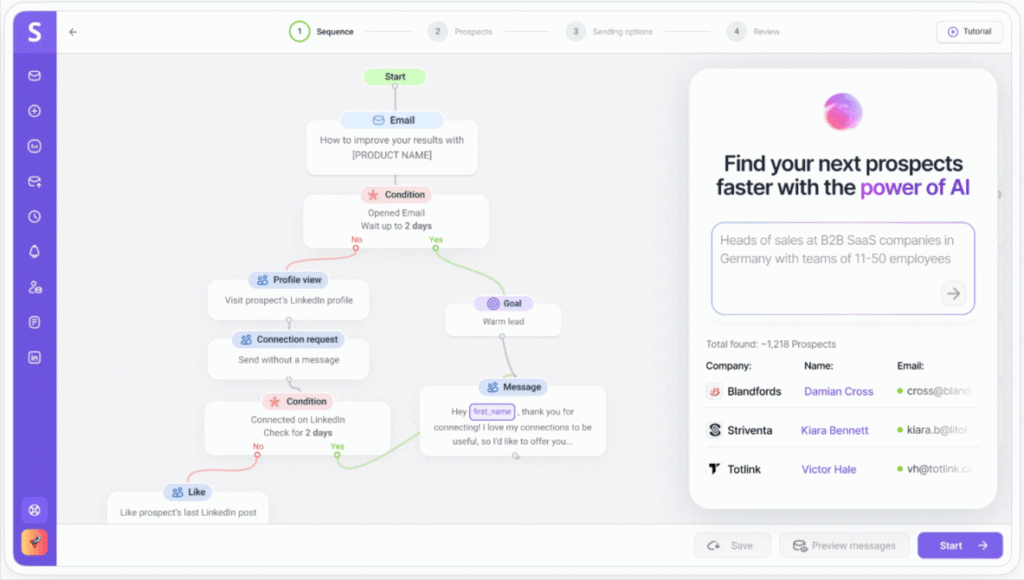
Snov.io’s prospecting tools allow users to search company and prospect data using different filters, while its Email Finder can find business contact information based on details such as a person’s name and company. The platform also supports LinkedIn-based prospect discovery.
For a small business owner, the value here isn’t simply “more contacts.” It’s reducing the amount of manual research required to turn a target company into an actual prospect you can work with.
Your Lead List Is Only as Good as Its Email Data
There is another problem we frequently see with outbound lead generation: people assume that finding an email address means they have a usable email address.
It doesn’t.
Addresses can become inactive, be entered incorrectly, belong to the wrong person, or simply be difficult to verify. Sending campaigns without paying attention to data quality can lead to wasted outreach and unnecessary delivery problems.
Snov.io includes a 7-tier email verification system and says its Email Finder results are pre-verified, while its verification tools are designed to identify invalid, abandoned, or otherwise unreachable addresses.
For someone building a prospect list manually, having verification in the same workflow can save another step. You can also use the verifier on contacts collected from other sources rather than relying exclusively on Snov.io for prospect discovery.
The Follow-Up Problem Is Bigger Than Most Businesses Realize
Getting the first email sent is not the same as running an outreach process.
A prospect may see your message and be interested but busy. They may need to discuss it internally. They may simply miss the email. If you send one message and never follow up, you may be giving up on an otherwise relevant opportunity.
Snov.io’s outreach system supports automated email sequences and unlimited follow-ups within its plans. Its recipient system charges for the initial contact, while follow-ups to the same recipient during the billing period don’t consume additional recipient quota.
This is one area where automation can be genuinely useful for a small team. Instead of relying on someone’s memory to decide who needs another message, the sequence can handle the repetitive part while the team focuses on actual conversations.
But Automation Isn’t the Same as Good Outreach
This is where we would be careful.
Putting 1,000 people into an automated sequence doesn’t automatically create 1,000 opportunities. If the audience is wrong or the message is generic, automation simply allows you to send the wrong message to more people, faster.
Our approach at SuperBuzz Media is to think about the offer and audience first, then use technology to make the repetitive parts easier. The tool should support the strategy rather than become the strategy.
Snov.io provides personalization, campaign controls, A/B testing on supported plans, follow-up options, analytics, and multichannel capabilities. Those features can help with execution, but the actual message still needs to give the prospect a reason to respond.
What About LinkedIn?
For many B2B businesses, email isn’t the only useful channel.
A prospect may be much more visible on LinkedIn than through their company website. Snov.io supports LinkedIn prospect discovery and offers a separate LinkedIn Automation product that can be combined with email sequences for multichannel outreach.
This can be useful when your sales process involves more than one touchpoint. Instead of thinking about email and LinkedIn as completely separate activities, you can build a sequence around both channels.
LinkedIn Automation is a separate paid component, though, so businesses should include that cost when evaluating the overall setup. Snov.io currently lists LinkedIn slots at $69 per month when purchased separately, with different pricing available in some bundled or annual arrangements.
One Dashboard Can Be More Useful Than Five Separate Tools
Another reason a business might explore Snov.io is consolidation.
A typical prospecting workflow can involve one tool for finding companies, another for email discovery, another for verification, another for outreach, a spreadsheet for tracking prospects, and a CRM for managing opportunities.
That setup isn’t necessarily wrong. But every additional tool introduces another login, another subscription, another integration, and another place where information can become disconnected.
Snov.io combines prospecting, email finding, verification, outreach, CRM and several integrations in one platform. It also supports integrations with services including HubSpot, Pipedrive, Zapier, Make and Calendly.
For a growing business, the value may therefore be less about having the “most powerful” individual feature and more about reducing the number of moving parts in the workflow.
How We’d Think About Snov.io for a Real Business
If we were setting up a prospecting process for a small B2B business, we wouldn’t start by buying a large plan and trying to use everything.
We’d first define the ideal customer. Then we’d build a relatively small prospect list, check the quality of the data, create a relevant outreach message, and test the response before increasing the volume.
A simple workflow could look like this:
Define your ICP → Find relevant companies → Identify decision-makers → Verify contacts → Segment prospects → Create outreach → Follow up → Measure responses → Improve the message
The important part is that every stage has a purpose. Snov.io can help with several of those stages, but the business owner still controls the most important decisions: who to contact, what to offer, and why that person should care.
What We Wouldn’t Expect Snov.io to Fix
This is worth saying because no lead-generation platform can solve every sales problem.
If your offer isn’t attractive, Snov.io won’t fix it. If you’re targeting the wrong industry, better prospecting data won’t suddenly make the audience interested. If your website doesn’t explain what you sell, or your sales team doesn’t respond to enquiries, automation won’t solve that either.
We’ve seen enough digital marketing campaigns to know that a technology problem and a marketing problem aren’t always the same thing. Sometimes businesses keep changing tools when what they actually need is a clearer audience, better messaging, or a better sales process.
That’s why we’d treat Snov.io as part of the system, not the entire system.
Is Snov.io Worth Exploring for Your Business?
If your business depends on finding B2B prospects, the platform is worth exploring because it brings several stages of prospecting and outreach together. You can start with the free Trial, which currently provides 50 credits, 100 recipients and one email warm-up slot, although some advanced features are restricted.
For businesses that need more volume, the current paid Sales Suite starts at $39 per month for Starter with 1,000 credits and 5,000 recipients. Higher Pro plans increase the available credits and recipient limits, while annual billing currently advertises a 25% saving.
But I wouldn’t recommend choosing a plan simply because it gives you more credits. Start with the number of prospects you realistically need, the channels you plan to use, and how much outreach you can actually personalize and manage.
The Bigger Lesson: Fix the Process Before Increasing the Volume
If your lead generation isn’t working, the first reaction is often to look for more leads.
Before doing that, look at the complete journey from prospect to conversation. Are you reaching the right companies? Are you talking to the right person? Is your data reliable? Is your message relevant? Are you following up? And are you learning from the responses you get?
Those questions are more important than the size of your database.
Snov.io can make several parts of that process easier, particularly prospect discovery, email finding, verification and automated outreach. But the businesses that get the most value from a tool like this are likely to be the ones that already understand who they want to reach and why that person should listen.
No. Snov.io is positioned as a broader sales and outreach platform. Its current toolset includes prospecting, email finding, email verification, cold-email campaigns, LinkedIn-related prospecting and automation, CRM, deliverability tools, analytics and integrations.
Can I use Snov.io for free?
Yes. Snov.io currently offers a renewable free Trial with 50 credits, 100 recipients and one warm-up slot. The Trial has restrictions on several advanced features, so it is primarily useful for testing the platform and workflow.
What are Snov.io credits used for?
Credits are used for prospect search, email search and email verification. Snov.io says each prospect and each email verification consumes one credit, with the exact use depending on the tool and action.
Does Snov.io automate follow-ups?
Yes. Snov.io supports automated email sequences and unlimited follow-ups within its plans. Follow-ups to the same recipient during the same billing period don’t consume additional recipient quota.
Can Snov.io work with LinkedIn?
Yes. Snov.io offers LinkedIn prospect discovery and a separate LinkedIn Automation product that can be used for LinkedIn actions and multichannel outreach.
Is Snov.io suitable for a small business?
It can be, particularly if the business sells B2B and needs a repeatable prospecting and outreach process. The free Trial provides a way to test the workflow before paying, while paid plans provide substantially larger quotas.
Final Thoughts
The biggest mistake in lead generation is assuming that more leads automatically means more sales.
In our experience working with businesses, the quality of the prospect, the accuracy of the contact data, the relevance of the offer and the consistency of follow-up can matter just as much as the number of names in a database.
That’s the reason Snov.io is worth exploring—not because it promises to magically generate customers, but because it can bring several repetitive parts of the prospecting and outreach process into one place. If you already know who your ideal customer is and you’re looking for a more structured way to find, verify, contact and follow up with prospects, it is a tool worth testing.
The goal shouldn’t be to build the biggest lead list. It should be to build a better pipeline.
AuthorProfile
Digital marketer and founder of SuperBuzz Media, with hands-on experience in performance marketing, lead generation, WordPress, AI automation, and digital marketing tools. I share practical insights, real-world experiences, and tool reviews to help businesses make smarter digital decisions.
If you’re looking for an email marketing platform that can help you build a subscriber list, create professional emails, automate follow-ups, build landing pages, and sell products, AWeber deserves a closer look.
But AWeber has changed quite a bit over the years. It is no longer just a traditional newsletter tool. Its current feature set includes AI writing tools, Canva integration, behavioral automation, dynamic content, web push notifications, ecommerce, advanced analytics, and even tools for managing email marketing through AI assistants.
So where does AWeber fit in today?
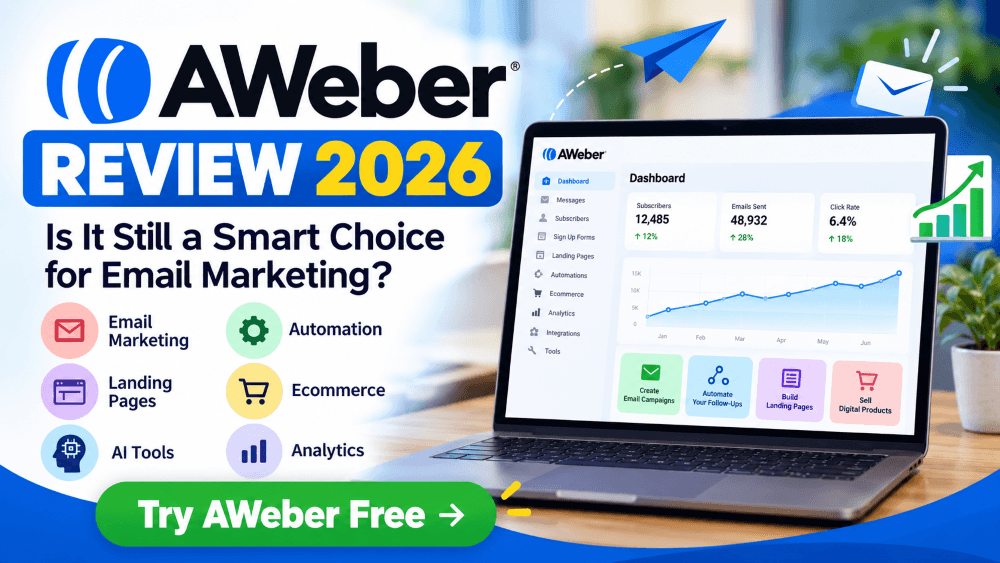
In this AWeber review 2026, we’ll look at its current features, pricing, automation, AI capabilities, ecommerce tools, landing pages, integrations, pros and cons, and who it makes the most sense for.
The goal is simple: give you enough information to decide whether AWeber deserves a place in your marketing stack.
So, What Is AWeber Actually Built For?
AWeber is an email marketing platform built primarily for businesses, creators, consultants, ecommerce sellers, newsletter publishers, and other users who want to build an audience and communicate with subscribers.
The basic idea is straightforward:
Traffic → Signup → Email → Automation → Customer
You can collect subscribers through signup forms and landing pages, send newsletters, create automated sequences, segment your audience, track performance, and connect AWeber with other tools.
That makes it useful for both simple newsletters and more structured lead-nurturing campaigns.
One thing that becomes clear in this AWeber review 2026 is that the platform has moved well beyond basic email broadcasting.
AWeber is built for emailing people who have subscribed to your list. If you want to contact new B2B prospects with cold email instead, you need a different kind of tool. See our Snov.io pricing breakdown for what that costs.
What Has Actually Changed Inside AWeber?
The biggest surprise for someone who hasn’t looked at AWeber recently is the number of newer features surrounding its core email marketing tools.
AWeber now highlights Canva integration, Theme Settings, Smart Designer, AI Subject Line Assistant, AI Writing Assistant, Newsletter Assistant, mobile editing, link previews, RSS-triggered emails, behavioral automation, dynamic content, tagging, segmentation, ecommerce, web push notifications, and more.
It also supports integrations with WordPress, Shopify, WooCommerce, Facebook, PayPal, Zapier, and hundreds of other apps.
In other words, AWeber is trying to make the entire email marketing workflow easier rather than simply giving you a box for writing newsletters.
That broader approach is one of the most important things to understand in this AWeber review 2026.
Can You Create Professional Emails Without Being a Designer?
Yes, and this is one of the areas where AWeber has added several useful features.
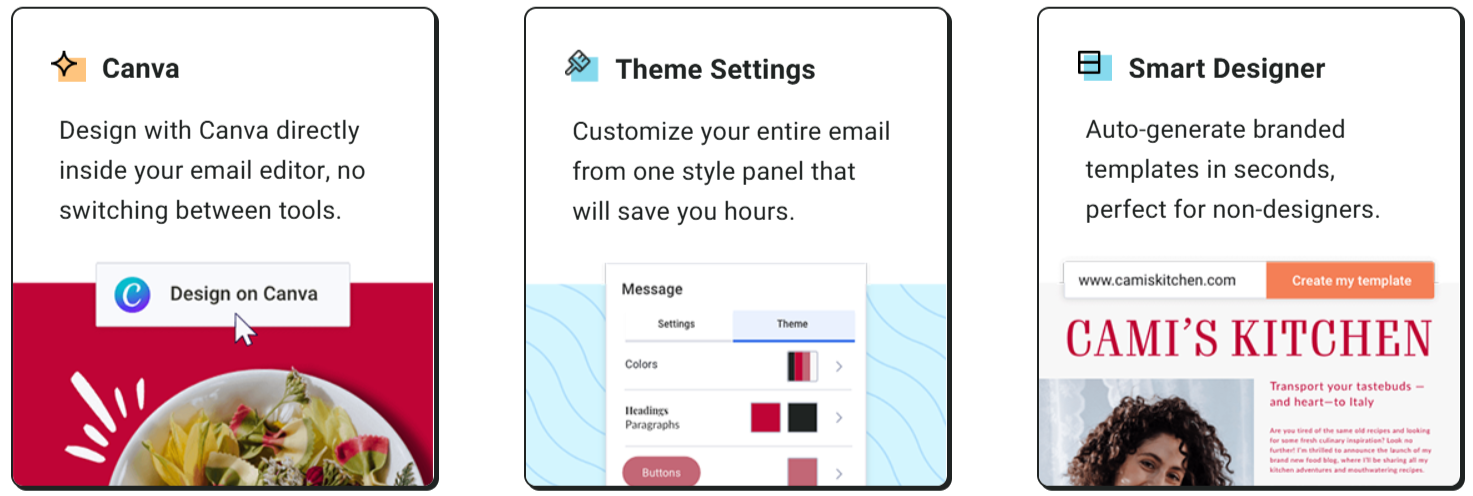
Canva Inside the Email Editor
AWeber now integrates Canva directly into its email editor.
That means you can work with Canva designs without constantly switching between separate tools.
For marketers who already use Canva for social posts, advertisements, presentations, or product graphics, this can make the email creation process much more convenient.
Theme Settings
Theme Settings allow you to control the overall appearance of an email from one place.
Instead of repeatedly changing fonts, colors, buttons, and other design elements, you can establish a consistent style and apply it across your emails.
This is especially useful for businesses that want their newsletters to maintain a consistent brand identity.
Smart Designer
Smart Designer can automatically generate branded email templates.
That can be useful if you know how you want your brand to look but don’t want to spend hours designing an email template from scratch.
Professional Images and Templates
AWeber also provides professional images and email templates that can speed up the design process.
Put all of these together and the platform becomes much more attractive to people who want professional-looking emails without needing a dedicated designer.
Does AWeber Use AI for More Than Just Writing?
Yes.
AI is now spread across several parts of the AWeber platform.
The current feature set includes an AI Subject Line Assistant, AI Writing Assistant, Newsletter Assistant, AI Landing Page Builder, and AI Signup Form Builder.
The subject line assistant can help generate ideas designed to make emails more noticeable.
The AI Writing Assistant can help create or improve email copy when you don’t want to start from a blank screen.
The Newsletter Assistant goes further by generating newsletter drafts automatically.
AWeber’s AI tools also extend into landing pages and signup forms.
That makes the AI functionality more useful than simply having a chatbot inside the email editor.
For a small business owner, the practical benefit is time.
You still control the strategy, offer, audience, and final message, but AI can reduce the time spent creating the first draft.
That’s a meaningful part of the modern AWeber review 2026 because the platform is increasingly combining traditional email marketing with AI-assisted workflows.
Can You Edit Emails From Your Phone?
AWeber also offers a mobile editor.
This can be useful when you need to create or edit an email while you’re away from your computer.
For example, a business running a limited-time offer might need to make a quick change before sending a campaign.
The mobile editor is designed to make that possible without requiring the entire campaign-building process to happen on a desktop.
AWeber also includes link previews, which can automatically turn links into more visual content inside emails.
These may seem like small features, but they can make everyday email creation considerably faster.
Can AWeber Automate Your Entire Follow-Up Process?
This is one of the areas where AWeber becomes much more interesting.
You can create automated email sequences that guide subscribers through a predefined journey.
For example:
Day 1: Welcome email
Day 2: Useful educational content
Day 4: Case study
Day 6: Product or service explanation
Day 8: Offer
Once the workflow is configured, the emails can be delivered automatically.
But AWeber also supports behavioral automation.
That means your automation can respond to what subscribers actually do rather than simply following a fixed calendar.
For example, someone who clicks a particular product link could receive a more relevant follow-up.
Someone who doesn’t engage could receive different content.
This makes AWeber more capable than a basic autoresponder system.
Can AWeber Automatically Send Your Blog Content?
Yes.
AWeber supports RSS-triggered emails.
This is useful if you regularly publish blog posts, podcasts, YouTube videos, or other RSS-enabled content.
Instead of manually creating a new email every time something is published, you can set up an automated process that sends new content to subscribers.
For a content-driven business, this can remove a surprisingly repetitive task.
Imagine publishing a new blog post and having your email marketing system automatically distribute it to your subscribers.
That is particularly useful for bloggers, publishers, and businesses that consistently create content.
Can You Personalize Emails for Different Subscribers?
Yes.
AWeber supports dynamic content, tagging, and segmentation.
These features allow you to make emails more relevant to different groups of subscribers.
For example, an ecommerce business could tag subscribers based on the products they interact with.
A marketing agency could segment subscribers based on their interests.
A course creator could separate new subscribers from existing customers.
Instead of sending exactly the same message to everyone, you can create more targeted communication.
This becomes increasingly important as your list grows.
Does AWeber Have Split Testing?
Yes.
AWeber’s current feature comparison includes email split testing, which can be useful when you want to test different versions of your campaigns.
You could test different:
Subject lines
Email content
Calls to action
Offers
Campaign approaches
The purpose is simple: instead of guessing what works, you can use actual campaign performance to make better decisions.
For marketers running regular campaigns, this can become an important part of optimization.
Does AWeber Have Good Deliverability Features?
Deliverability is one of those things you don’t notice when it works, but it becomes extremely important when it doesn’t.
AWeber highlights its in-house deliverability team and infrastructure as part of its effort to help emails reach subscriber inboxes.
The platform also lists detailed deliverability reporting among its higher-level features.
That can give marketers more information about how their campaigns are performing from a delivery perspective.
Of course, no email platform can guarantee that every message will reach the inbox.
Your sender reputation, content, list quality, authentication, engagement, and sending practices still matter.
Can You Build Landing Pages Inside AWeber?
Yes.
AWeber includes landing page tools for lead generation, promotions, products, and other marketing campaigns.
You can use landing pages for:
Lead magnets
Newsletter subscriptions
Webinars
Product launches
Digital products
Service inquiries
Special offers
AWeber’s current feature set also includes video landing pages, Google Analytics, domain connection, Facebook Pixel tracking, and ecommerce functionality on applicable plans.
That means an AWeber landing page can do more than simply collect an email address.
That’s a useful setup for a small business that wants to keep its lead-generation system relatively simple.
And if your website is on WordPress, you can connect AWeber with it rather than rebuilding your website.
For example, if you’re researching Hostinger WordPress hosting for your website, your eventual setup could be:
WordPress Website + AWeber + Meta Ads
That gives you separate tools for the website, traffic generation, and email follow-up.
Can You Sell Products and Services Through AWeber?
Yes.
AWeber has an ecommerce component that lets users sell products and services through its platform.
The current feature set includes subscriptions and payment plans, sales tracking, and purchase tagging.
This can be particularly useful for creators and small businesses selling digital products.
For example, you could create a landing page for an ebook, collect payment, and then use purchase information to tag the customer.
That tag can then be used in future email automation.
This creates a much more connected workflow:
Visitor → Lead → Customer → Repeat Customer
AWeber’s current pricing page also lists ecommerce transaction fees of 0.6% on Plus and 1.0% on Lite, in addition to applicable payment processor fees.
What About Web Push Notifications?
One of the newer features that deserves attention is web push notifications.
AWeber’s current pricing page lists functionality for collecting web push subscribers, sending messages, and accessing analytics.
This gives businesses another way to communicate with visitors beyond email.
It could be useful for:
Publishers
Ecommerce stores
Content websites
Bloggers
Businesses with frequent promotions
It also shows how AWeber is expanding beyond traditional email marketing.
Can AWeber Help You Build a Link-in-Bio Page?
AWeber’s current platform navigation also includes a Link in Bio page feature.
This is aimed at creators and businesses that want a simple page containing multiple links from one shareable URL.
For someone promoting content through Instagram, YouTube, or other social platforms, a link-in-bio page can act as a central destination.
You can use it to direct visitors toward your website, newsletter, products, landing pages, or other important resources.
What Is AWeber MCP and How Does It Work With AI?
AWeber has also introduced AWeber MCP, which is designed to let users interact with their email marketing through AI assistants such as ChatGPT or Claude.
The idea is interesting.
Instead of constantly navigating through dashboards and reports, you can interact with your email marketing using conversational instructions.
AWeber says users can ask about opens and clicks, create a welcome series, schedule broadcasts, and get recommendations.
This moves AI beyond simply generating email copy.
It starts becoming an interface for actually working with your marketing data and campaigns.
As this is a newer capability, check AWeber’s current documentation for supported actions and availability before building a workflow around it.
Can AWeber Connect With Other Marketing Tools?
Yes.
AWeber supports integrations with popular platforms including:
WordPress
Shopify
WooCommerce
Facebook
PayPal
Zapier
And hundreds of other integrations
This matters because most businesses already use several tools.
It can become the email and subscriber-management layer inside your existing technology stack.
If you’re researching Hostinger pricing 2026 for your website, for example, the hosting decision and email marketing decision can be treated separately. Your website can run on your preferred hosting platform while AWeber handles email marketing.
AWeber Pricing 2026: What Are You Actually Paying For?
Pricing is one of the most important parts of this AWeber review 2026 because the cost changes as your subscriber list grows.
AWeber’s current pricing structure includes:
Free
Lite
Plus
Unlimited
Done For You
The current pricing page shows annual starting prices of $12.49/month for Lite and $19.99/month for Plus at the 0–500 subscriber level. The page currently lists monthly pricing of $15/month for Lite and $30/month for Plus at 500 subscribers.
The exact price increases as your subscriber count grows.
For example, the current pricing table lists Lite at $35/month for 2,500 subscribers and $60/month for 5,000 subscribers.
Plus is listed at $55/month for 2,500 subscribers and $90/month for 5,000 subscribers.
AWeber also offers a Free plan with up to 500 subscribers and 3,000 emails per month.
So when looking at AWeber pricing 2026, don’t focus only on the starting price.
Look at what happens when your list grows.
AWeber Free
The Free plan is aimed at people who are just getting started.
It currently supports up to 500 subscribers and 3,000 email sends per month.
It includes one list profile and one workflow automation.
That makes it a useful way to learn the platform without immediately committing to a subscription.
AWeber Lite
Lite is designed for creators and businesses that need more than the basic plan.
At the 0–500 subscriber level, the current pricing page lists Lite at $12.49/month when billed annually or $15/month when billed monthly.
The plan includes:
1 email list
3 landing pages
3 email automations
3 users
1 custom segment
24/7 support
Advanced message analytics
AWeber Plus
Plus is where the platform becomes considerably more capable.
The current annual starting price is $19.99/month for the 0–500 subscriber tier.
Plus includes:
Unlimited email lists
Unlimited landing pages
Unlimited email automations
Unlimited custom segments
Unlimited users
Priority 24/7 support
Advanced reporting and analytics
Advanced landing page features
Sales tracking
Lower ecommerce transaction fees
AWeber branding removal
The current monthly price at 500 subscribers is $30.
AWeber Unlimited
AWeber also has an Unlimited option for larger operations.
Businesses with very large subscriber lists can contact AWeber for high-volume pricing.
The current pricing page lists tiers up to 150,000 subscribers, while businesses with more than 100,000 subscribers are directed to contact AWeber.
AWeber Done For You
This is another feature that deserves attention.
AWeber’s Done For You service is aimed at businesses that don’t want to build their email marketing system themselves.
The current offer includes an email marketing setup built by AWeber experts, including emails, landing pages, workflows, integrations, branding, signup forms, a welcome series, newsletter drafts, a 1:1 setup call, and 30 days of unlimited edits.
The current pricing page shows this service at $20/month billed annually plus a $79 setup fee as part of its current offer.
For a busy business owner, that can be an interesting alternative to spending hours learning the platform.
Which AWeber Plan Should You Start With?
This is another important point in our AWeber review 2026.
If you’re just starting, Free gives you an opportunity to learn the platform.
If you’re building a small business or creator brand and need more landing pages and automation, Lite may be enough.
If email marketing is already an important part of your business, Plus provides a much larger feature set.
And if you’re operating at very high volume, AWeber can discuss a larger custom setup.
The important point is that you don’t need to start with the most expensive option.
Choose based on what you’re actually using today.
Also remember that your other business costs are separate.
For example, if you are checking Hostinger renewal price for your website, that is a hosting expense and doesn’t need to be bundled into your email marketing decision.
AWeber vs Systeme.io: Email Specialist or All-in-One Platform?
AWeber and Systeme.io overlap, but their philosophies are different.
AWeber is heavily centered around email marketing.
Systeme.io is designed as a broader all-in-one online business platform that combines email, funnels, automation, websites, courses, and other business functions.
So if email is the center of your marketing strategy, AWeber’s focused approach can be attractive.
If you want one platform to handle a wider range of online-business functions, Systeme.io may be worth investigating.
The right choice depends on how much of your business you want to manage inside one platform.
AWeber vs Other Email Marketing Platforms
AWeber also competes with platforms such as Kit, MailerLite, Moosend, Sender, GetResponse, and ActiveCampaign.
Some are designed primarily for creators.
Some focus heavily on advanced automation.
Others combine email with ecommerce, CRM, funnels, or broader marketing features.
This means feature count alone isn’t a useful way to choose.
Instead, look at your actual workflow.
Do you need simple newsletters?
Do you need behavioral automation?
Do you need landing pages?
Do you sell products?
Do you need web push?
Do you need advanced segmentation?
Do you want AI assistance?
Once you answer those questions, it becomes much easier to compare platforms.
What I Like About AWeber
There are several things that stand out positively in this AWeber review 2026.
A Strong Email Foundation
Email remains at the center of the platform, which makes the overall product relatively easy to understand.
Plenty of Automation
You get traditional automated sequences as well as behavioral automation.
Useful AI Tools
AI isn’t limited to one writing feature. It appears across subject lines, writing, newsletters, landing pages, and signup forms.
Good Content Creation Tools
Canva integration, Smart Designer, templates, professional images, and Theme Settings make it easier to produce professional-looking emails.
Ecommerce Features
You can sell products and services, support payment plans, track sales, and use purchase tagging.
Multiple Ways to Reach Your Audience
Email is still the main channel, but AWeber now also offers web push notifications and other audience-building features.
Strong Integration Options
Connections with WordPress, Shopify, WooCommerce, Facebook, PayPal, Zapier, and hundreds of other tools make it easier to fit AWeber into an existing marketing stack.
Where AWeber Could Be Better
AWeber isn’t necessarily the right choice for every business.
If you want a complete CRM, sophisticated sales pipeline, course platform, website builder, and business automation system in one product, you may want to look at broader all-in-one platforms.
Pricing also becomes more important as your subscriber list grows.
And advanced marketers should compare automation depth and segmentation capabilities against dedicated marketing automation platforms before committing.
None of this makes AWeber a bad choice.
It simply means the platform should be evaluated according to your own requirements.
Who Is AWeber Best Suited For?
AWeber can make sense for:
Small businesses
Creators
Bloggers
Coaches
Consultants
Freelancers
Ecommerce businesses
Newsletter publishers
Marketing teams
It is particularly useful for people who want to build an audience they can communicate with directly instead of depending entirely on social media reach.
AWeber Makes Sense If…
You want email marketing to be a central part of your business.
You want automation without building an extremely complicated system.
You want landing pages and signup forms included.
You want ecommerce capabilities.
You want AI tools to speed up content creation.
You want web push as an additional communication channel.
You want a platform that can connect with the tools you already use.
You May Want Something Else If…
You want an all-in-one business platform with extensive CRM, sales, courses, funnels, and website capabilities.
You need very advanced enterprise-level automation.
Or you simply don’t need more than a basic newsletter tool.
In those cases, comparing alternatives before committing makes sense.
How I Would Start With AWeber
If you’re new to email marketing, don’t try to use every feature on day one.
Start with a simple system:
Step 1: Create your account.
Step 2: Create a signup form or landing page.
Step 3: Give visitors a useful reason to subscribe.
Step 4: Create a welcome email.
Step 5: Build a short automated sequence.
Step 6: Start sending useful content.
Step 7: Add segmentation once your list grows.
Step 8: Add ecommerce, behavioral automation, or web push when you actually need them.
If your website is built using an AI-based hosting or website-building workflow, you can also keep the two systems separate. For example, you might use Hostinger AI website builder for getting the website online and AWeber for the email marketing layer.
And if your website eventually needs more server resources, you can separately explore Hostinger cloud hosting without changing your email marketing system.
That flexibility is useful because your website and email platform don’t have to come from the same company.
AWeber Review 2026: The Bottom Line
After looking at the current feature set, AWeber is much more than a traditional newsletter platform.
You get email creation tools, AI assistance, automation, behavioral targeting, segmentation, landing pages, ecommerce, web push notifications, analytics, integrations, and tools designed to make everyday marketing work faster.
That doesn’t mean every business needs every feature.
But it does mean AWeber gives you plenty of room to start simple and gradually build a more sophisticated marketing system.
For creators and small businesses especially, that flexibility can be useful.
Final Thoughts: Is AWeber Worth Trying in 2026?
This AWeber review 2026 comes down to a fairly simple question: do you want a dedicated email marketing platform that can grow with your business?
If the answer is yes, AWeber is still worth putting on your shortlist.
You can start with the Free plan, create your first signup form, build a welcome sequence, and learn how your audience responds.
As your business grows, you can add segmentation, behavioral automation, ecommerce, advanced reporting, web push, and other features when they actually become useful.
That’s a sensible way to approach marketing software.
You don’t need to use every feature on day one. You simply need a platform that gives you the tools to move forward.
And that’s where AWeber has become considerably more interesting.
It has retained its focus on email while adding modern AI, automation, ecommerce, personalization, analytics, and audience-building features around it.
So if you’re looking for a practical email marketing platform that you can start small with and expand as your business grows, AWeber is definitely worth trying.
The best way to find out whether it fits your workflow is to actually use it.
Start with a small campaign, build a simple automation, and see how the platform feels in practice.
AWeber is worth considering if you want email marketing, automation, landing pages, segmentation, ecommerce, analytics, and AI-assisted marketing tools in one platform.
Is AWeber free?
Yes. AWeber offers a Free plan for up to 500 subscribers and 3,000 email sends per month.
What is AWeber used for?
AWeber is used to build email lists, send newsletters, automate follow-ups, create landing pages, segment subscribers, track campaigns, and sell products and services.
Does AWeber have AI?
Yes. AWeber currently offers AI features for subject lines, email writing, newsletters, landing pages, and signup forms.
Does AWeber have behavioral automation?
Yes. AWeber supports behavioral automation that can respond to subscriber actions.
Can AWeber send blog posts automatically?
Yes. AWeber supports RSS-triggered emails, which can be used to automatically send new content to subscribers.
Can you sell products through AWeber?
Yes. AWeber includes ecommerce features for selling products and services, including subscriptions, payment plans, sales tracking, and purchase tagging.
Does AWeber have web push notifications?
Yes. AWeber’s current platform includes web push functionality for collecting subscribers, sending messages, and analytics.
Does AWeber integrate with WordPress?
Yes. AWeber lists WordPress integration along with Shopify, WooCommerce, Facebook, PayPal, Zapier, and hundreds of other integrations.
Is AWeber better than Systeme.io?
The two platforms focus on somewhat different needs. AWeber is centered around email marketing, while Systeme.io provides a broader all-in-one online business platform.
Which AWeber plan should a beginner use?
A beginner can start with the Free plan and upgrade when additional subscribers, automations, landing pages, or other features become necessary.
AuthorProfile
Digital marketer and founder of SuperBuzz Media, with hands-on experience in performance marketing, lead generation, WordPress, AI automation, and digital marketing tools. I share practical insights, real-world experiences, and tool reviews to help businesses make smarter digital decisions.
If you are running an online business, you probably already know how quickly your list of marketing tools can grow.
You might need one tool for landing pages, another for email marketing, another for sales funnels, another for online courses, and another for affiliate management. Before long, you’re paying for several subscriptions and trying to connect everything together.
Systeme.io takes a different approach. It combines sales funnels, email marketing, website building, automation, online courses, affiliate management, CRM pipelines and several other business tools inside one platform. The company currently says more than 500,000 entrepreneurs use the platform.
So, is Systeme.io actually useful, or is an all-in-one platform simply trying to do too many things?
In this Systeme.io review 2026, we’ll look at its features, pricing, ease of use, strengths, limitations and the types of businesses it makes sense for.
What Is Systeme.io?
Systeme.io is an all-in-one online business and marketing platform designed to bring several common business tools together.
Instead of separately subscribing to funnel software, email marketing software, course software and affiliate management tools, you can manage many of those functions from the same dashboard.
Its current feature set includes sales funnels, email marketing, website and blog building, marketing automation, online courses, communities, booking calendars, CRM pipelines, webinars, physical products, affiliate management and more.
The idea is fairly simple: use fewer tools and keep more of your business in one place.
That doesn’t mean Systeme.io will replace every tool you currently use. But for a small business, creator, coach, consultant or course seller, having these features connected can reduce a lot of technical work.
Systeme.io Features at a Glance
Here are the main things you can do inside Systeme.io:
Feature
What you can use it for
Sales funnels
Landing pages, opt-in funnels, sales funnels and checkout flows
Email marketing
Broadcasts, sequences, tagging and segmentation
Automation
Trigger-based marketing workflows
Website builder
Build websites and landing pages without separate hosting
Blog
Publish blog content from the same platform
Online courses
Create and sell courses
Communities
Build a private community for members
Affiliate management
Run your own affiliate program
CRM pipelines
Manage leads and sales opportunities
Booking calendar
Allow prospects or customers to book meetings
Webinars
Create evergreen webinar funnels
E-commerce
Sell physical products
Sub-accounts
Manage multiple businesses or clients
Payment integrations
Connect supported payment providers
The interesting part is that many of these aren’t separate add-ons. Systeme.io’s current pricing page lists the major platform features across its plans, with the main differences being limits such as contacts, funnels, courses and other usage allowances.
Ready to try Systeme.io? Start with the free plan and explore the platform before deciding whether you need a paid plan.
Sales funnels are one of the main reasons people look at Systeme.io in the first place.
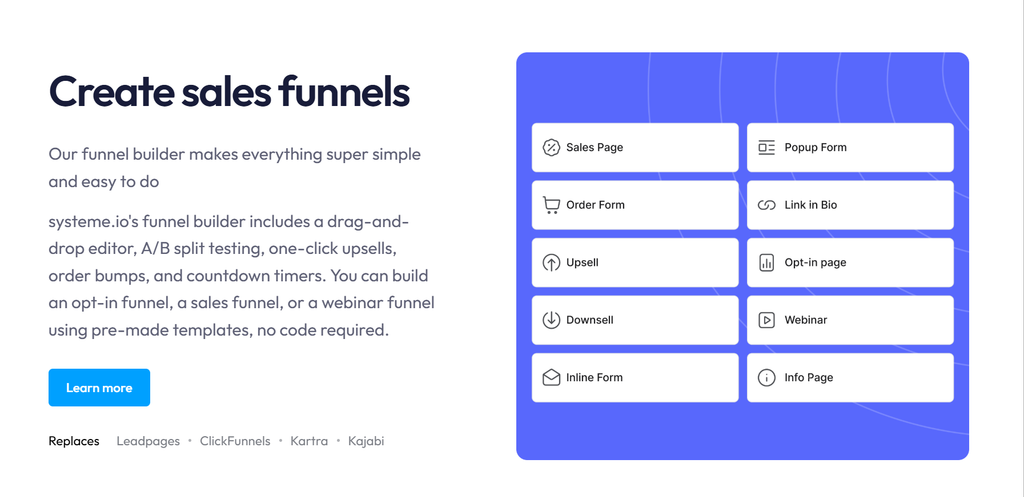
The platform provides a drag-and-drop funnel builder along with templates for different types of funnels. You can create opt-in pages, sales pages, checkout pages and other steps without having to code everything yourself.
You can also add features such as:
A/B testing
Order bumps
One-click upsells
Countdown timers
Forms
Checkout pages
Email automation
This is useful because the landing page, contact list, email sequence and other funnel components can live inside the same platform.
If you’re interested specifically in funnels, we’ll go much deeper into this in our upcoming Systeme.io sales funnel guide.
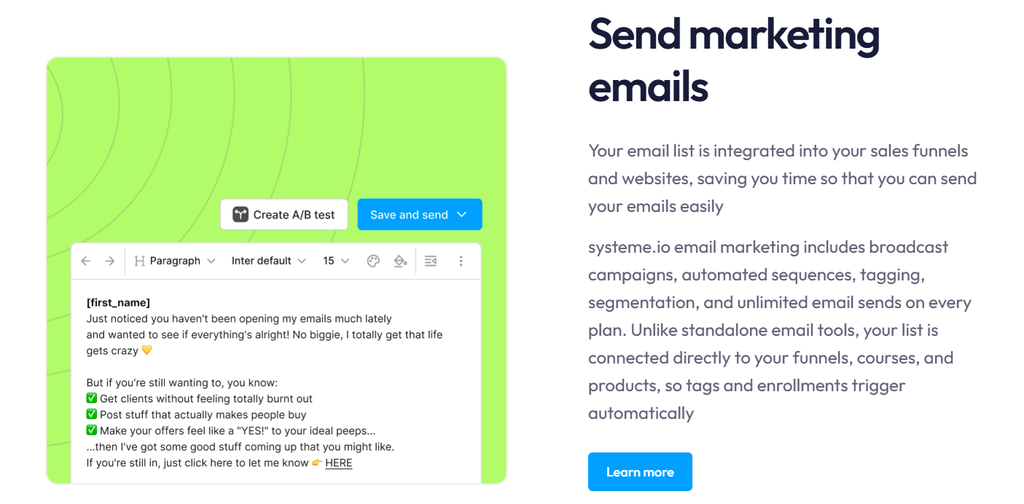
You can send broadcasts, create automated email sequences, tag contacts and segment your audience. The platform says unlimited email sending is included across its plans.
The bigger advantage is the connection between email and the rest of the platform.
For example, someone could fill out a form on your landing page, become a contact, receive a tag and enter an automated email sequence without you having to manually move that person between different systems.
That makes Systeme.io particularly interesting for lead generation and sales funnels.
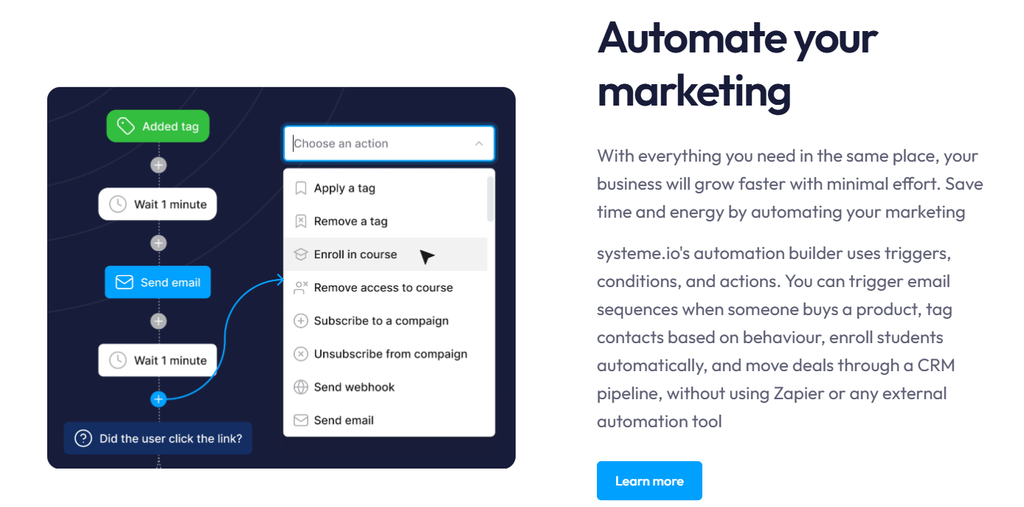
3. Marketing Automation
Automation is where an all-in-one platform can become genuinely useful.
Instead of manually sending every follow-up email or updating every contact, you can create rules and workflows that respond to actions taken by your visitors or customers.
For example:
Visitor submits form → contact added → tag applied → email sequence starts → sales offer sent → purchase triggers next action
The exact workflow will depend on your business, but the basic idea is to connect different marketing activities together.
Systeme.io currently includes automation rules and workflows as part of its platform.
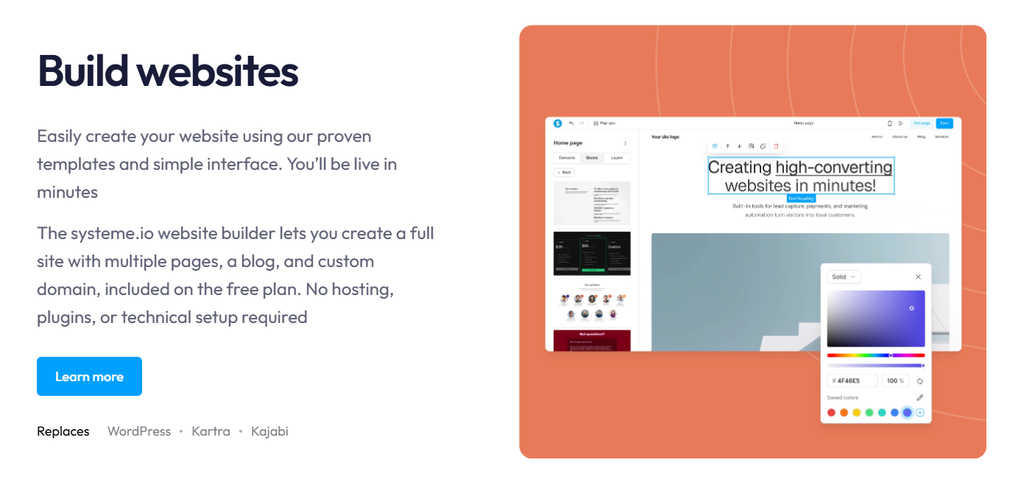
4. Website and Blog Builder
Systeme.io isn’t limited to sales funnels.
You can also build a website and blog using its website builder. The company says its website builder supports multiple pages, blogs and custom domains without requiring separate hosting or plugins.
This is particularly interesting for someone who doesn’t want to manage WordPress hosting, themes, plugins and technical maintenance.
However, there’s an important trade-off.
If you need the enormous ecosystem of WordPress themes, plugins and custom development options, WordPress still gives you a different level of flexibility.
For example, if you’re comparing an all-in-one platform with a traditional WordPress setup, it’s worth understanding the costs and infrastructure behind Hostinger WordPress hosting before deciding which approach makes sense.
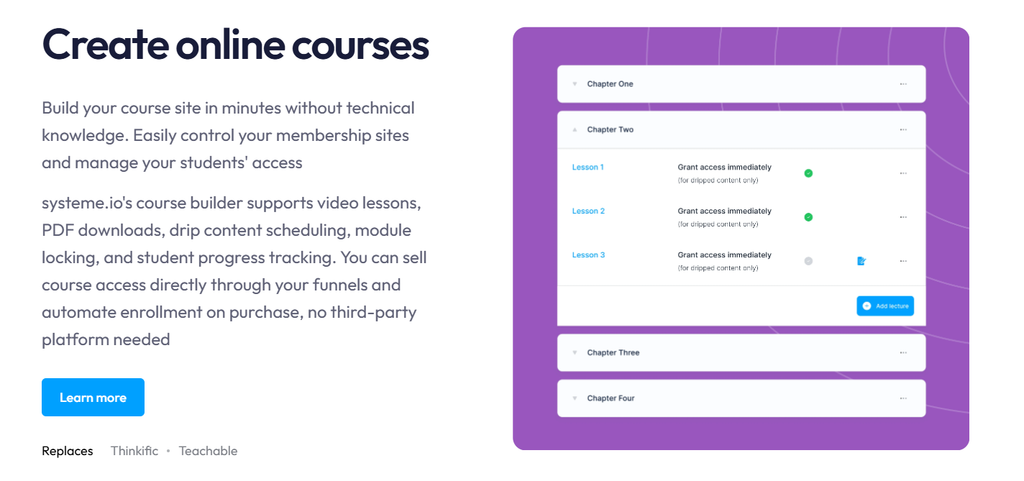
5. Online Course Builder
If you’re a coach, consultant, trainer or creator, the course builder can be one of the more useful features.
Systeme.io allows you to create and sell online courses and manage students from the same platform. The current pricing page lists courses and student management among the platform’s core features.
This means you don’t necessarily need a separate course platform just to deliver your content.
You can connect the course to your funnel, collect payment and automate parts of the customer journey from the same system.
6. Affiliate Management
Systeme.io also lets businesses create and manage their own affiliate programs.
That means you can allow other people to promote your products or services and manage their affiliate relationships from within the platform.
This can be useful if you’re selling courses, digital products, memberships or other offers where affiliate marketing makes sense.
Interestingly, affiliate marketing is also part of Systeme.io’s own business model.
Systeme.io currently offers affiliates 60% lifetime commissions on qualifying sales, according to its official affiliate documentation. The referral is associated with the affiliate ID in its database.
7. CRM and Pipelines
Systeme.io has also expanded beyond traditional funnel and email software.
The platform currently includes CRM pipelines that can be used to track leads and sales opportunities.
This can be useful for service businesses where the journey isn’t simply:
Visitor → Purchase
Instead, you might have:
Lead → Contacted → Qualified → Proposal → Negotiation → Won
Having that information alongside your funnels and marketing activities can simplify the overall workflow.
8. Booking Calendar
The platform also includes a booking calendar.
That can be useful for consultants, coaches, agencies and other service providers who need prospects to schedule calls.
Instead of sending someone to a completely separate booking platform, you can potentially keep the booking process connected to the rest of your funnel.
It’s another example of Systeme.io’s overall philosophy: combine the basic tools needed to run an online business instead of connecting a dozen separate applications.
9. Webinars and Communities
Systeme.io also supports evergreen webinars and online communities.
Evergreen webinars are useful when you want a recorded presentation to work as part of an automated funnel rather than hosting a live event every time.
Communities can be useful for creators, educators and membership-based businesses that want to provide an additional space for customers or students.
These aren’t necessarily features everyone will use. But having them available means you may not need another subscription when your business expands into these areas.
Systeme.io Pricing 2026
Pricing is one of the strongest parts of the platform.
As of the current official pricing page, Systeme.io has four main plans:
Plan
Price
Contacts
Key limits/features
Free
$0/month
2,000
3 funnels, 1 course
Startup
$17/month
5,000
More funnels and courses
Webinar
$47/month
10,000
Adds automated webinars
Unlimited
$97/month
Unlimited
Full limits plus additional features
Systeme.io’s pricing page was last updated in April 2026 and currently lists the Startup plan at $17/month, Webinar at $47/month and Unlimited at $97/month. Annual billing provides two months free according to the current pricing page.
The Free plan is permanent, rather than being a short trial. It supports up to 2,000 contacts, three sales funnels, one course, one affiliate program and one custom domain, while email sending and file storage are unlimited.
That makes it possible to test the platform before committing to a paid subscription.
We’ll cover the plans, limits and pricing in much more detail in our dedicated Systeme.io pricing 2026 article.
Is the Systeme.io Free Plan Actually Useful?
Yes, especially if you’re starting out.
The free plan isn’t simply a stripped-down demo that expires after a few days. According to the current pricing information, it remains free and doesn’t require a credit card.
You get access to many of the platform’s core tools, but usage limits apply.
For example, the current plan information lists 2,000 contacts, three sales funnels and one course on the free tier.
For someone building their first lead-generation funnel or selling a small course, that can be enough to get started.
Once your contact list or number of funnels grows, you can upgrade rather than immediately moving to another platform.
Is Systeme.io Easy to Use?
The platform is clearly designed around simplicity.
Its funnel builder uses drag-and-drop editing, and many of the major functions are available from the same dashboard.
That can be a major advantage for someone who doesn’t want to spend hours connecting APIs, plugins and third-party services.
However, “easy to use” doesn’t mean there is nothing to learn.
If you’re building your first funnel, automation or online course, you’ll still need to understand how those systems work. Systeme.io can simplify the technology, but it can’t replace the strategy behind your marketing.
Systeme.io vs a WordPress-Based Business
This is one of the more important comparisons to make.
With WordPress, you can build almost anything, but you typically assemble your technology stack yourself.
You might have:
WordPress
Web hosting
Elementor
Email marketing software
Funnel software
Course plugin
Payment plugins
Booking software
Affiliate software
Automation tools
An all-in-one platform takes a different approach.
Systeme.io puts many of these functions under one roof.
For a traditional WordPress setup, you may want to compare the cost of Hostinger pricing 2026 with the subscription cost of an all-in-one platform.
You should also consider renewal costs. Our Hostinger renewal price guide explains why the initial hosting price isn’t always the number you should use when calculating long-term costs.
And if you’re specifically interested in using AI to create websites, our Hostinger AI website builder review covers another approach to building a website without starting from scratch.
The choice isn’t simply about which platform has more features. It’s about whether you value flexibility or consolidation more.
What About Performance and Scalability?
Systeme.io’s advantage is that you don’t have to manage traditional hosting infrastructure for the websites and funnels you build inside the platform.
That removes several technical responsibilities.
You aren’t worrying about WordPress plugin conflicts, server configuration or hosting-level maintenance for those pages.
On the other hand, businesses with more demanding technical requirements may still prefer a traditional hosting environment.
For example, if you’re running a complex WordPress site and eventually need additional server resources, you might move from shared hosting to Hostinger cloud hosting or another infrastructure solution.
So Systeme.io isn’t necessarily a replacement for every type of website.
It’s better understood as a business platform built around marketing, selling and delivering products or services online.
Systeme.io Pros
All-in-one platform
You can manage funnels, email, websites, courses, automation and other business functions from one account.
Permanent free plan
The free plan gives beginners a way to test the platform without a short trial deadline.
Unlimited email sending
Unlimited email sending is included across the current plans, although other limits such as contacts and funnels still apply.
Built-in automation
You don’t necessarily need a separate automation platform for basic marketing workflows.
Course and membership features
Creators can sell courses and manage students without adding a separate course platform.
Affiliate management
Businesses can run their own affiliate program inside the platform.
Multiple business functions in one dashboard
This can reduce the number of subscriptions and integrations you need to maintain.
Systeme.io Cons
It isn’t a replacement for every specialist tool
A dedicated email marketing, CRM, course or automation platform may provide more advanced functionality in a specific area.
There is still a learning curve
Even though the interface is designed to be simple, building effective funnels and automations requires some marketing knowledge.
Advanced customization can be limited
An all-in-one platform generally won’t provide the same level of technical freedom as building a completely custom stack.
Limits still matter
The free plan is generous, but funnels, contacts, courses and other resources have limits depending on the plan.
You may not need all the features
If you only need email marketing, paying for an all-in-one platform may not make sense compared with using a dedicated email service.
Who Should Use Systeme.io?
Systeme.io makes the most sense for businesses that want several marketing functions connected together.
It can be particularly relevant for:
Coaches
Consultants
Course creators
Digital product sellers
Freelancers
Small agencies
Affiliate marketers
Online educators
Membership businesses
Small online businesses
Entrepreneurs building their first funnel
It can also be useful for someone who is tired of maintaining a large collection of separate marketing tools.
Who May Not Need Systeme.io?
You may not need an all-in-one platform if your business already has a mature technology stack that works well.
For example, a large company with dedicated CRM, marketing automation, e-commerce and analytics systems may not gain much from replacing everything with one platform.
Likewise, if your primary requirement is a highly customized WordPress website, Systeme.io may not give you the same flexibility.
The important question isn’t:
“Does Systeme.io have enough features?”
It clearly has a lot.
The better question is:
“Does putting these features together make my business easier to run?”
Is Systeme.io Worth It in 2026?
For someone who wants to build funnels, collect leads, send emails, automate marketing and potentially sell courses or digital products, Systeme.io offers a lot in one platform.
The permanent free plan also makes the decision easier because you can test the core system before paying.
The main trade-off is flexibility. You are choosing a more consolidated platform rather than assembling a completely customized technology stack.
For a small online business, creator or service provider, that trade-off can be useful. For a business with highly specialized technical requirements, separate specialist tools may still make more sense.
So rather than looking at Systeme.io as a replacement for every other piece of software, I’d look at it as an option for simplifying the marketing technology stack.
If you want to try it, you can start with the free plan before deciding whether you need a paid subscription.
👉 [YOUR SYSTEME.IO AFFILIATE LINK] — Start Systeme.io for free
Frequently Asked Questions
Is Systeme.io really free?
Yes. Systeme.io currently offers a permanent Free plan. It supports up to 2,000 contacts, three sales funnels and one course, among other limits. No credit card is required to start.
How much does Systeme.io cost in 2026?
The current plans are Free, Startup at $17/month, Webinar at $47/month and Unlimited at $97/month. Annual billing currently provides two months free.
Can Systeme.io replace WordPress?
It can replace WordPress for certain types of websites and marketing pages, particularly when simplicity is more important than extensive customization. However, WordPress remains a different type of platform with a much larger plugin and development ecosystem.
Can I sell courses with Systeme.io?
Yes. Systeme.io includes an online course builder and student management functionality. The number of courses you can create depends on your plan.
Does Systeme.io include email marketing?
Yes. Email marketing is built into the platform, including broadcasts, automated sequences, tagging and segmentation. Systeme.io says unlimited email sending is included on its plans.
Does Systeme.io have affiliate management?
Yes. You can create and manage an affiliate program for your own products and offers from inside the platform.
Does Systeme.io have a CRM?
Yes. Systeme.io currently includes CRM pipelines for tracking leads and sales opportunities.
Is Systeme.io good for beginners?
It can be a good starting point for beginners who want funnels, email marketing, automation and other business tools in one place. However, beginners still need to learn the fundamentals of funnels and digital marketing to get meaningful results.
Does Systeme.io charge transaction fees?
The current pricing page states that Systeme.io does not charge additional transaction fees for payments through supported processors such as Stripe and PayPal. Normal fees charged by the payment provider can still apply.
Ready to try Systeme.io? Start with the free plan and explore the platform before deciding whether you need a paid plan.
Digital marketer and founder of SuperBuzz Media, with hands-on experience in performance marketing, lead generation, WordPress, AI automation, and digital marketing tools. I share practical insights, real-world experiences, and tool reviews to help businesses make smarter digital decisions.
Hostinger is popular because it combines low introductory pricing with WordPress hosting, AI tools, CDN, backups, and a relatively simple management experience.
But it isn’t the right fit for every website.
You may be looking for Hostinger alternatives because of renewal pricing, resource requirements, server location, support preferences, WordPress features, or simply because you want to compare several providers before committing.
In this guide, we’ll look at seven Hostinger alternatives in 2026 and explain what each one offers, who it may suit, and what to check before switching.
The goal isn’t to declare one hosting company the winner. Different hosting environments make sense for different websites.
Why Look for Hostinger Alternatives?
There are several legitimate reasons someone might start researching Hostinger alternatives.
The first is pricing.
Hostinger’s current India web hosting promotion starts at ₹69/month for the Single plan on a 48-month term, but that plan renews at ₹289/month. Premium currently starts at ₹149/month and renews at ₹449/month. Check Hostinger’s Current Hosting Plans
If you’re planning to keep your website for several years, the renewal price becomes an important part of the calculation.
Our Hostinger pricing 2026 guide breaks down the current plans, upfront costs, and renewal prices in more detail.
Other reasons include:
You want cPanel.
You need a different server location.
You want a particular WordPress environment.
You need more advanced cloud infrastructure.
You prefer a specific support model.
You need different resource limits.
You’re managing multiple websites.
You want pay-as-you-go cloud hosting.
You’re moving away from shared hosting.
So there isn’t one universal reason to consider Hostinger alternatives.
What Should You Compare Before Switching?
Don’t compare hosting providers based only on the promotional monthly price.
Look at the complete package.
Important things to compare include:
Introductory price
Renewal price
Billing period
Number of websites
Storage
Backup frequency
CDN
SSL
Email
WordPress support
Migration
Server locations
Resource limits
Customer support
Control panel
Refund policy
Upgrade options
A hosting plan that costs slightly more may provide a feature you actually need.
At the same time, paying significantly more for resources you won’t use doesn’t necessarily make sense.
1. Bluehost
Bluehost is one of the more recognizable Hostinger alternatives, particularly for people building WordPress websites.
Its current India web hosting plans start at ₹199/month for the Starter plan on a 36-month term, with renewal listed at ₹349/month. The Starter plan currently includes 10 websites, 10 GB NVMe storage, AI site creation tools, a free domain for the first year, free migration tools, CDN, managed WordPress updates, and a 99.99% uptime SLA.
The Business plan currently starts at ₹279/month and supports up to 50 websites with 50 GB NVMe storage. Its listed features include malware scanning and removal, staging, CDN, backups, and additional security features.
Who might consider Bluehost?
Bluehost can be worth comparing if you’re primarily interested in WordPress and want features such as managed WordPress updates, staging, NVMe storage, and AI-assisted website creation.
It’s also useful to compare the actual pricing rather than assuming that a familiar hosting brand will be cheaper or more expensive.
We’ve already covered the Hostinger vs Bluehost comparison separately, including pricing, WordPress features, security, and renewal costs.
2. SiteGround
SiteGround is another option frequently considered by people researching Hostinger alternatives, especially when support, managed WordPress features, and performance tools are important.
SiteGround currently lists its StartUp plan at $2.99/month for the introductory period and GrowBig at $4.99/month. GrowBig renews at $29.99/month when prepaid annually.
The current plans include features such as free SSL, CDN, backups, email, website migration, caching, and WordPress management.
GrowBig also includes features such as staging, on-demand backups, and additional performance resources.
Who might consider SiteGround?
SiteGround may be worth investigating if you want managed WordPress features and are comfortable with a higher renewal price than many budget-oriented hosting plans.
Its cloud hosting is also a separate option for websites that need dedicated resources.
SiteGround currently lists its entry cloud plan at $100/month, with 4 CPU cores and 8 GB memory.
That puts its cloud offering into a very different price category from entry-level shared hosting.
3. DreamHost
DreamHost is another established provider worth including when researching Hostinger alternatives.
Its current web hosting plans are priced in US dollars.
The Launch plan currently starts at $2.89/month for the first year and renews at $10.99/month. It includes 25 websites, 25 GB NVMe storage, daily automated backups, free SSL, a free domain for one year, and a 30-day money-back guarantee.
The Growth plan currently starts at $3.99/month for the first year and supports 50 websites and 50 GB NVMe storage.
DreamHost also offers managed WordPress hosting and VPS hosting.
Its current VPS Business plan starts at $13.75/month for the first year and includes unlimited websites, 60 GB NVMe storage, 2 CPU cores, and 2 GB RAM.
Who might consider DreamHost?
DreamHost can be relevant if you’re looking for a provider with a range of shared, managed WordPress, and VPS options.
It may also be worth considering if you want daily backups and generous website limits on its shared plans.
Remember that its pricing is displayed in USD, so Indian customers should consider currency conversion and applicable taxes when comparing total costs.
4. Namecheap
Namecheap is widely known for domains, but it also provides shared hosting, WordPress hosting, VPS, and other hosting products.
Its current shared hosting plans include cPanel, WordPress installation through Softaculous, SSL certificates, email hosting, and 24/7 live chat support. (namecheap.com)
As of May 2026, Namecheap updated its shared hosting renewal prices.
The current listed renewal prices are $5.88/month for Stellar, $7.88/month for Stellar Plus, and $11.88/month for Stellar Business.
Namecheap’s current shared hosting comparison also lists 20 GB SSD storage for Stellar, unmetered SSD for Stellar Plus, and 50 GB SSD for Stellar Business.
Who might consider Namecheap?
Namecheap can be interesting if you already manage domains there or specifically want a traditional cPanel-based hosting environment.
It also provides free hosting migration for new hosting plans, according to its current hosting information.
For someone who wants hosting and domain management from the same provider, it’s worth putting on the comparison list.
5. GoDaddy
GoDaddy is another major provider and one of the most familiar Hostinger alternatives for website owners.
Its current India website shows traditional hosting products alongside Managed WordPress and its website builder.
GoDaddy’s current pricing page lists Managed Hosting for WordPress from ₹849/month on an annual term, with daily backups and WordPress-focused management. (godaddy.com)
Traditional GoDaddy web hosting is a separate product from Managed WordPress hosting.
That’s important when comparing the two companies.
You shouldn’t compare Hostinger’s WordPress hosting with GoDaddy’s website builder or managed WordPress product and assume they’re equivalent services.
If GoDaddy is one of the providers you’re considering, our existing Hostinger vs GoDaddy article compares their hosting products, features, pricing, and renewal considerations in more detail.
Who might consider GoDaddy?
GoDaddy may be relevant if you already manage domains or other services there, or if you want to keep domains, hosting, website building, and business services under one account.
The important thing is to compare the specific hosting product rather than the GoDaddy brand as a whole.
6. BigRock
For Indian website owners, BigRock is another provider worth checking.
This option is particularly relevant because of the changes involving HostGator India.
HostGator India and BigRock joined forces in July 2025. HostGator’s current India website says new customers should head to BigRock for the same products and services, while existing customers manage their accounts through BigRock. (hostgator.in)
BigRock’s current Linux hosting plans start at ₹69/month for the Standard plan and renew at ₹409/month.
The Standard plan currently includes one website, 20 GB NVMe storage, 200 GB transfer, 10 email accounts, unlimited databases, daily backups, cPanel, and free Let’s Encrypt SSL.
Its Business plan currently starts at ₹159/month and supports five websites with 25 GB NVMe storage and daily backups. (bigrock.in)
Who might consider BigRock?
BigRock can be worth considering if you’re specifically looking for an India-focused hosting option with cPanel, NVMe storage, email accounts, daily backups, and local support options.
It is also particularly relevant if you’re currently researching HostGator alternatives in India, because of the current relationship between the two brands.
7. Cloudways
Cloudways is quite different from the other Hostinger alternatives in this list.
It focuses on managed cloud hosting rather than traditional low-cost shared hosting.
Cloudways currently offers managed hosting for WordPress, Magento, Laravel, and PHP applications. Its Flexible platform currently starts at $11/month for a configuration with 1 vCPU, 2 GB RAM, 50 GB storage, and 2 TB bandwidth. (cloudways.com)
Cloudways also uses a pay-as-you-go billing model, so billing can depend on actual usage and the infrastructure configuration selected.
Its current platform includes features such as managed security, free migration, vertical scaling, caching, and server/application management tools.
Who might consider Cloudways?
Cloudways becomes more relevant when you’re moving beyond basic shared hosting.
It can be worth investigating for:
Growing WordPress websites
Ecommerce
Agencies
Multiple websites
Higher-traffic projects
Applications requiring cloud infrastructure
The pricing is considerably higher than entry-level shared hosting, so it shouldn’t be viewed as a direct replacement if your primary requirement is simply the lowest hosting cost.
Hostinger Alternatives 2026: Quick Comparison
Here’s a simplified comparison of the seven providers.
Provider
Current entry pricing*
Hosting style
Useful for
Bluehost
₹199/mo
Shared / WordPress
WordPress and business websites
SiteGround
$2.99/mo
Shared / WordPress / Cloud
Managed WordPress
DreamHost
$2.89/mo
Shared / WordPress / VPS
Websites needing multiple hosting levels
Namecheap
$2.28/mo advertised comparison
Shared / WordPress / VPS
Budget hosting and domains
GoDaddy
Varies by product
Shared / Managed WordPress
Websites and business services
BigRock
₹69/mo
Shared / WordPress / VPS
Indian businesses
Cloudways
$11/mo
Managed Cloud
Growing and higher-resource websites
*Prices are promotional or starting prices displayed by providers and can depend on billing period, taxes, location, and product. Always check the provider’s current checkout price before purchasing.
The table isn’t a ranking.
These providers offer different combinations of price, resources, management, infrastructure, and support, so the appropriate choice depends on your website.
Hostinger Alternatives for WordPress
If you’re specifically looking for Hostinger alternatives for WordPress, don’t compare only the advertised monthly price.
Look at the WordPress management features.
Important things to check include:
Automatic updates
Staging
Backups
CDN
Caching
Object caching
Malware protection
WordPress migration
PHP management
WP-CLI
SSH access
SiteGround, Bluehost, DreamHost, and Cloudways all offer WordPress-focused products, but they approach managed WordPress hosting differently.
If you’re currently happy with Hostinger’s WordPress environment, you may want to read our Hostinger WordPress hosting review before deciding whether you actually need to move.
Hostinger Alternatives for Small Business
For a small business website, you usually don’t need the most powerful hosting available.
A typical business website may contain:
Home
About
Services
Contact
Blog
Testimonials
Lead forms
WhatsApp integration
A standard shared hosting plan can handle this type of website when it’s properly configured.
The decision becomes more complicated when the website is an important part of the business and starts receiving significant traffic.
In that situation, you might look at providers such as SiteGround, Bluehost, DreamHost, or Cloudways depending on your requirements.
If you’re still deciding whether you should leave Hostinger, our Hostinger review 2026 covers its current pricing, WordPress features, AI tools, performance considerations, and renewal costs.
Hostinger Alternatives for Ecommerce
Ecommerce websites have different requirements from basic business websites.
A WooCommerce store may have hundreds or thousands of products, customer accounts, payment processing, search functionality, inventory management, and multiple plugins.
As the store grows, database and server requirements can increase.
Cloudways may be worth investigating for higher-resource ecommerce projects because its platform is designed around managed cloud infrastructure. (cloudways.com)
SiteGround also offers managed WordPress and cloud hosting, while Bluehost provides WooCommerce-focused tools on its current hosting plans. (siteground.com)
For a small store, however, you may not need cloud hosting immediately.
Start with the actual resource requirements rather than assuming ecommerce automatically requires expensive hosting.
Hostinger Alternatives for Developers
Developers often have different requirements from typical WordPress users.
You may need:
SSH
WP-CLI
Git
Custom PHP versions
APIs
Docker
Server configuration
Staging
Cron jobs
Cloud infrastructure
Cloudways, DreamHost VPS, SiteGround’s developer tools, and other VPS/cloud providers can be worth investigating depending on the application.
SiteGround’s current GrowBig plan, for example, includes SSH, WP-CLI, staging, Git, and multiple PHP versions. (siteground.com)
If you’re building custom applications rather than simply running WordPress, don’t restrict your search to traditional shared hosting.
Hostinger Alternatives for Indian Websites
If most of your visitors are in India, server location can matter.
Latency between the visitor and the server can affect network response times, although it is only one part of overall website performance.
Indian users may also care about:
INR pricing
GST handling
Local support
Payment options
Indian data centers
Migration assistance
BigRock is particularly relevant in this context because its current India hosting plans are displayed in INR and its hosting pages are designed specifically for the Indian market. (bigrock.in)
Cloud providers can also be worth investigating if you need a specific cloud region.
Don’t Switch Just Because of the Introductory Price
One of the biggest mistakes when researching Hostinger alternatives is comparing only the first-year price.
Almost every major hosting provider uses promotional pricing in some form.
The renewal price can be substantially different.
For example, SiteGround currently lists GrowBig at $4.99/month on its introductory offer and $29.99/month on renewal. (siteground.com)
DreamHost’s Launch plan currently starts at $2.89/month for the first year and renews at $10.99/month. (dreamhost.com)
Namecheap has also updated its shared hosting renewal prices during 2026. (namecheap.com)
This is why you should calculate the long-term cost, not just the promotional monthly rate.
You can also compare this with our detailed Hostinger renewal price guide.
Do You Actually Need to Leave Hostinger?
Before moving your website, ask yourself what problem you’re trying to solve.
If the problem is website speed, check your images, caching, plugins, CDN, and hosting resources first.
If the problem is renewal cost, compare the complete cost of another provider rather than just its introductory price.
If the problem is technical limitations, identify the specific feature you’re missing.
If you’re looking for more server resources, compare cloud and VPS options rather than moving from one shared host to another.
Sometimes the right solution is changing hosting.
Sometimes it’s simply optimizing the website or upgrading your existing plan.
How Difficult Is It to Move From Hostinger?
Moving a website doesn’t necessarily mean rebuilding it.
A typical migration can involve:
Backing up the existing website.
Purchasing the new hosting plan.
Copying website files.
Migrating the database.
Configuring the domain.
Checking email.
Testing the website.
Updating DNS.
Monitoring the site after the DNS change.
Several providers offer migration assistance or migration tools.
Bluehost currently includes a free site migration tool on its Starter plan, while SiteGround lists free website transfer as a feature across its hosting plans. (bluehost.com) (siteground.com)
Don’t cancel your existing hosting immediately.
Keep the old hosting active until you’ve confirmed that the website, email, DNS, forms, and other important services are working correctly on the new platform.
Hostinger Alternatives 2026: Which One Should You Consider?
Instead of looking for one universal replacement, match the provider to your situation.
Bluehost
Consider it if your priority is WordPress-focused hosting, managed updates, staging, and an India-specific hosting offering.
SiteGround
Consider it if you want managed hosting with caching, backups, WordPress tools, and a more premium pricing structure.
DreamHost
Consider it if you want a provider offering shared hosting alongside managed WordPress and VPS options.
Namecheap
Consider it if domain management and traditional cPanel hosting are important to you.
GoDaddy
Consider it if you already use GoDaddy for domains or other business services and want to keep services together.
BigRock
Consider it if you’re specifically looking for an India-focused hosting provider with INR pricing, cPanel, NVMe storage, and daily backups.
Cloudways
Consider it if you’re moving toward managed cloud hosting and need more infrastructure flexibility than traditional shared hosting.
These are different hosting approaches, not seven identical products.
Frequently Asked Questions
What are the best Hostinger alternatives in 2026?
There are several providers worth comparing, including Bluehost, SiteGround, DreamHost, Namecheap, GoDaddy, BigRock, and Cloudways. The appropriate choice depends on your website type, budget, traffic, technical requirements, and desired hosting environment.
Which Hostinger alternative is good for WordPress?
Bluehost, SiteGround, DreamHost, and Cloudways all offer WordPress-focused hosting options. Compare their caching, backups, staging, migration, support, and renewal pricing before choosing.
Is Bluehost cheaper than Hostinger?
The answer depends on the plan and billing period. Bluehost currently lists its India Starter plan at ₹199/month on a 36-month term, while Hostinger’s current Single plan is ₹69/month on a 48-month term. Their features and website limits are also different. (bluehost.com) (hostinger.com)
Is SiteGround cheaper than Hostinger?
Their promotional pricing is not directly comparable because they use different billing periods and pricing structures. SiteGround currently lists StartUp at $2.99/month and GrowBig at $4.99/month for the introductory period, with significantly higher renewal prices. (siteground.com)
Is DreamHost available for WordPress?
Yes. DreamHost offers both general web hosting and managed WordPress hosting, including DreamPress. Its current WordPress products include features such as backups, migrations, staging on applicable plans, and WordPress support. (dreamhost.com)
Is BigRock related to HostGator India?
Yes. HostGator India and BigRock joined forces in July 2025. HostGator’s current India website directs new customers to BigRock and existing customers to BigRock for account management. (hostgator.in)
Is Cloudways suitable for a basic website?
It can host basic websites, but its managed cloud pricing is considerably higher than entry-level shared hosting. Its current Flexible platform starts at $11/month, so it makes more sense to compare it when you need managed cloud infrastructure or additional resources. (cloudways.com)
Should I switch from Hostinger?
That depends on why you’re considering a move. Compare the specific problem you’re trying to solve with the features, total cost, resource limits, and management experience offered by the alternative.
Final Thoughts
There are plenty of Hostinger alternatives in 2026, but moving to another hosting company isn’t automatically an upgrade.
The right choice depends on what you need from your hosting.
A small WordPress website may need simplicity and predictable costs.
A growing business may care more about backups, staging, support, and scalability.
A developer may need SSH, Git, APIs, and server-level control.
A high-traffic ecommerce website may need managed cloud infrastructure.
That’s why it’s better to compare hosting based on your actual requirements instead of choosing purely on the lowest promotional price.
And before you move, check your current Hostinger plan carefully.
If your main issue is renewal pricing, performance, or resources, there may be a simpler solution than migrating an entire website.
Check Hosting Options Before You Switch
If you’re currently comparing providers, check the plans, renewal prices, storage, backups, and website limits before making a decision.
Digital marketer and founder of SuperBuzz Media, with hands-on experience in performance marketing, lead generation, WordPress, AI automation, and digital marketing tools. I share practical insights, real-world experiences, and tool reviews to help businesses make smarter digital decisions.
Before trying to speed up WordPress on Hostinger, it’s important to understand what you’re actually trying to improve.
Website speed isn’t simply about getting a 100/100 score in PageSpeed Insights. What matters more is how quickly the important content appears, how quickly the page responds when someone interacts with it, and whether the layout stays stable while loading.
Google’s Core Web Vitals currently focus on three important measurements: LCP, INP, and CLS.
For a good user experience, Google recommends an LCP of 2.5 seconds or less, an INP below 200 milliseconds, and a CLS score below 0.1.
These numbers are useful targets, but don’t treat them as the only measure of website quality.
Test Your Website Before Making Changes
The first step to speed up WordPress on Hostinger is to test the website before changing anything.
Use tools such as Google PageSpeed Insights, Google Search Console, Lighthouse, or GTmetrix.
Don’t test only the homepage.
Check your homepage, important service pages, popular blog posts, product pages, and landing pages. A website can have a fast homepage while a large blog post or ecommerce page performs poorly.
Also run the test more than once.
Caching can affect the first request, so a single test isn’t always representative of the experience your visitors receive. Hostinger itself recommends testing multiple times when evaluating LiteSpeed Cache settings.
One of the biggest advantages of using Hostinger for WordPress is its LiteSpeed-based hosting environment.
Hostinger says its current WordPress hosting uses LiteSpeed and includes WordPress optimization features such as LiteSpeed Cache and Object Cache on eligible plans.
If you’re trying to speed up WordPress on Hostinger, this should be one of the first things you check.
You can find the LiteSpeed option inside your Hostinger WordPress dashboard. Hostinger’s current documentation also provides optimization profiles that allow you to apply pre-configured LiteSpeed settings.
2. Use LiteSpeed Cache Properly
Hostinger currently provides the LiteSpeed Cache plugin pre-installed with its hosting accounts.
That means you generally don’t need to search for another caching plugin immediately after setting up WordPress.
LiteSpeed Cache can handle several optimization functions, including page caching, browser caching, CSS and JavaScript optimization, image optimization, and integration with CDN services.
The most important thing is to configure it carefully.
Hostinger currently provides three LiteSpeed optimization profiles:
Basic
Advanced
Aggressive
Hostinger describes Advanced as the recommended profile for all website types, while Aggressive applies more advanced optimizations.
If you’re working on a production website, I wouldn’t immediately switch everything to the most aggressive settings.
Apply the settings, clear the cache, and test your website after each major change.
3. Enable Page Caching
Page caching is one of the easiest ways to speed up WordPress on Hostinger.
Without caching, WordPress may need to process PHP code and database queries every time a visitor requests a page.
With caching enabled, a previously generated version of the page can be served instead, reducing the amount of work required from the server.
Hostinger currently recommends keeping the main Enable Cache setting switched on in LiteSpeed Cache.
Caching is particularly useful for pages that don’t change every few seconds.
A blog post, service page, About page, or standard landing page can often benefit significantly from caching.
4. Don’t Use Multiple Cache Plugins
One of the easiest ways to create problems while trying to speed up WordPress on Hostinger is to install several caching plugins.
For example, you might already have LiteSpeed Cache and then install another plugin because someone recommended it in a YouTube video.
That can create conflicts.
Two different plugins may try to control the same caching, minification, JavaScript, CSS, or optimization functions.
Hostinger’s current Cache Manager documentation recommends using only one cache plugin at a time for WordPress.
If you’re using LiteSpeed Cache, configure it properly before installing another optimization plugin.
5. Enable Object Cache If Your Plan Supports It
Object Cache works differently from normal page caching.
Instead of storing an entire webpage, it stores frequently accessed database information in memory. This can reduce repeated database queries and help WordPress retrieve information more efficiently.
Hostinger currently offers LiteSpeed Memcached Object Cache on eligible plans. Its documentation says Object Cache reduces database load by storing frequently accessed information in memory.
You can check your Hostinger dashboard to see whether the feature is available for your plan.
This can be particularly useful for websites with more dynamic content, such as WooCommerce stores, membership websites, or larger WordPress websites.
6. Optimize Your Images
Large images are one of the most common reasons WordPress websites become slow.
You might have excellent hosting and caching, but a page containing several 2 MB images can still take a long time to load.
Before uploading an image, resize it to something close to the dimensions you actually need.
There’s little benefit in uploading a 5000-pixel-wide photograph when your website displays it at 1200 pixels.
Also consider modern formats such as WebP where appropriate.
Hostinger’s current LiteSpeed optimization tools include image optimization and resizing features.
7. Don’t Over-Optimize Images
Image compression is useful, but don’t reduce image quality to the point where your website looks unprofessional.
For a business website, product website, or photography portfolio, image quality still matters.
The goal is to find the balance between visual quality and file size.
A properly compressed 150–300 KB image can often look virtually identical to a much larger original image while requiring considerably less data to download.
8. Optimize Your Largest Image First
If you want to speed up WordPress on Hostinger, don’t spend all your time optimizing tiny images at the bottom of the page.
Start with the largest important element visible when the page loads.
This is often the hero image or main banner.
A huge hero image can directly affect Largest Contentful Paint, one of Google’s Core Web Vitals.
Make sure the image is correctly sized, compressed, and delivered efficiently.
At the same time, don’t blindly lazy-load the main LCP image. The browser needs to discover and load important above-the-fold content quickly.
9. Use a CDN
A Content Delivery Network can help deliver your website’s static resources from locations closer to your visitors.
This becomes particularly useful when your visitors are spread across different cities or countries.
Hostinger currently provides its own CDN on eligible plans. Its documentation says the CDN can cache website content and work together with LiteSpeed Cache.
If you’re using Hostinger CDN, remember that there can be multiple caching layers involved.
Your WordPress cache, Hostinger CDN, browser cache, and other services can all have different cached versions.
That’s why clearing the correct cache is important when making website changes.
10. Clear Your Cache After Major Changes
Sometimes your website isn’t actually slow or broken.
You’re simply looking at an old cached version.
Hostinger currently allows WordPress users to flush the cache from the WordPress section of the hosting dashboard.
You should consider clearing the relevant cache after making major changes to:
CSS
JavaScript
Images
Page layouts
WordPress themes
Important plugins
CDN configuration
After clearing the cache, test the page again in an incognito window.
11. Remove Unnecessary WordPress Plugins
Plugins add functionality to WordPress, but every additional plugin can potentially add scripts, styles, database queries, or background processes.
That doesn’t mean you should avoid plugins.
Instead, remove plugins that you don’t actually need.
Go through your WordPress dashboard and look for plugins that are:
No longer being used
Replaced by another plugin
Duplicating functionality
Loading unnecessary scripts
Abandoned or outdated
Keeping your plugin collection under control is one of the simplest ways to keep WordPress manageable.
12. Avoid Duplicate Optimization Plugins
This deserves separate attention because it’s very common.
You may have LiteSpeed Cache handling caching and optimization, another plugin handling image compression, a third plugin handling database cleanup, and another plugin trying to optimize JavaScript.
Some of these combinations can work.
But adding plugins without understanding what each one does can create conflicts.
Before installing a new optimization plugin, check whether LiteSpeed Cache or Hostinger already provides the same functionality.
This is especially important when trying to speed up WordPress on Hostinger, because Hostinger’s current ecosystem already includes several performance features.
13. Be Careful With Elementor
If you’re using Elementor, your page builder can have a noticeable effect on page weight.
This doesn’t mean Elementor is automatically slow.
The problem is usually how the builder is used.
A page containing dozens of nested containers, animations, sliders, widgets, background videos, popups, and third-party elements will generally require more browser processing than a simple page.
Try to keep your important pages reasonably clean.
Use animations when they add something to the design, rather than adding them simply because the option exists.
14. Reduce Heavy JavaScript
JavaScript allows your website to do useful things, but excessive JavaScript can delay interaction.
Look at the scripts being loaded by:
Analytics
Advertising
Chat widgets
Social media
Popups
Booking tools
Forms
Marketing automation
Tracking platforms
You don’t necessarily need to remove these tools.
Instead, identify which ones are actually contributing to your business.
If three different tools are performing similar functions, consider whether you really need all three.
15. Optimize CSS
Your website’s CSS controls its visual appearance, but large amounts of unused CSS can increase the amount of work the browser has to perform.
LiteSpeed Cache provides CSS optimization options, including minification.
Minification removes unnecessary characters from files and can reduce their size.
However, CSS optimization can occasionally cause visual problems.
After changing CSS optimization settings, check:
Homepage
Mobile menu
Buttons
Forms
Blog posts
Header
Footer
Elementor sections
Don’t assume the website is working correctly just because the homepage looks fine.
16. Be Careful With JavaScript Delay
JavaScript delay can improve initial loading by postponing non-critical scripts.
But it can also break interactive elements.
For example, you might discover that:
A popup no longer opens.
A form doesn’t submit.
A menu stops working.
A tracking script doesn’t fire.
An Elementor widget behaves incorrectly.
If you enable aggressive JavaScript optimization, test the website thoroughly.
The goal is to speed up WordPress on Hostinger without breaking the website that you’re trying to improve.
17. Optimize Your Fonts
Fonts are often overlooked.
If your website loads several font families and many different font weights, the browser has to download additional files.
For most business websites, one or two font families are usually enough.
You can also reduce unnecessary font weights.
For example, if you’re only using regular and bold text, there’s little reason to load ten different font variations.
18. Avoid Heavy Video Backgrounds
Video backgrounds can look impressive, but they can also create a significant performance cost.
This is particularly important on mobile devices.
If you have a large video playing automatically in the hero section, consider replacing it with a static image or a lightweight video preview.
You can still use video elsewhere on the website.
Just make sure the first thing visitors see isn’t forcing their browser to download and process a large video file before they can interact with the page.
19. Lazy Load Images Below the Fold
Visitors don’t need to download every image on a long webpage immediately.
Images further down the page can often be lazy-loaded so that they are requested closer to the point where the visitor needs them.
This reduces the amount of content the browser needs to process during the initial page load.
However, don’t blindly lazy-load everything.
Important above-the-fold images, especially your main LCP element, should generally be available as quickly as possible.
20. Reduce Third-Party Scripts
Third-party scripts are another common source of unnecessary page weight.
A marketing website may have:
Google Analytics
Google Tag Manager
Meta Pixel
WhatsApp widget
Facebook widgets
Chat software
Heatmap tools
YouTube embeds
Advertising scripts
Some of these are important.
But every script adds work for the browser.
Review your website periodically and remove tracking or marketing tools that you’re no longer using.
This can be particularly helpful for websites that have accumulated plugins and marketing integrations over several years.
21. Optimize YouTube Embeds
YouTube videos are useful for blogs and landing pages, but a normal embedded YouTube player can load a significant amount of additional code.
If you’re using several videos on one page, consider using a thumbnail or lightweight video-loading technique that loads the actual player only when the visitor interacts with it.
This is particularly useful for long-form blog posts containing multiple video embeds.
22. Keep WordPress and Plugins Updated
Keeping WordPress updated is important for security and compatibility, but updates can also contain performance improvements.
Keep your:
WordPress core
Plugins
Theme
WooCommerce
PHP version
reasonably up to date.
Before major updates, make sure you have a working backup.
If you use managed WordPress hosting, some updates and WordPress management features may be handled through the hosting environment. Hostinger currently promotes automated WordPress updates and related management tools on its WordPress hosting products.
23. Use a Supported PHP Version
WordPress runs on PHP, so the PHP version used by your hosting environment can affect both compatibility and performance.
Using a very old PHP version isn’t a good long-term strategy.
At the same time, don’t switch to the newest available version on a production website without checking whether your theme and plugins support it.
Make the change carefully and test the website afterward.
24. Clean Up Your WordPress Database
As a website grows, the WordPress database can accumulate unnecessary information.
This may include:
Old post revisions
Auto drafts
Spam comments
Trashed content
Expired transients
Unused metadata
Database cleanup can help keep a large WordPress installation manageable.
But don’t blindly delete database tables or run aggressive cleanup tools.
Always create a backup first, especially if you’re running WooCommerce, membership functionality, or other database-heavy plugins.
25. Check Your Hosting Resource Usage
If you’ve optimized your website but it still becomes slow during busy periods, check your hosting resource usage.
The problem may not be your images or CSS.
Your website could simply be reaching the limits of its current hosting environment.
Look for signs such as:
High CPU usage
Memory limitations
Slow database queries
Resource spikes
PHP worker limitations
Traffic-related slowdowns
If your website consistently reaches its limits, upgrading the hosting environment may make more sense than continuing to optimize individual files.
If you’re considering the different hosting levels, our Hostinger pricing 2026 guide explains the current plans and renewal costs.
26. Don’t Upgrade to VPS Too Quickly
A VPS can provide more resources and control, but it isn’t automatically the solution to a slow WordPress website.
First identify why the website is slow.
If the problem is a 5 MB hero image, moving to a VPS won’t fix the underlying issue.
If the problem is excessive plugins, upgrading hosting doesn’t eliminate those plugins.
If the website is genuinely reaching its resource limits, however, a more powerful hosting environment may help.
Our Hostinger VPS vs shared hosting guide explains when moving to VPS makes sense and when shared hosting is still sufficient.
27. Consider Cloud Hosting for a Growing Website
If your website has outgrown normal shared hosting but you don’t necessarily want to manage a VPS yourself, cloud hosting can be another option.
Hostinger’s current cloud hosting environment includes features such as LiteSpeed, CDN, ObjectCache, NVMe storage, and managed WordPress tools.
This can be relevant for growing ecommerce stores, agencies, and websites experiencing higher traffic.
We’ve covered the subject in more detail in our Hostinger cloud hosting review.
28. Don’t Forget About Renewal Costs
Performance isn’t the only thing to consider when choosing hosting.
Your hosting plan is part of your website’s long-term operating cost.
Promotional hosting prices can be considerably lower than renewal prices, so check the cost before committing to a plan.
Our Hostinger renewal price guide explains what happens when the initial promotional period ends and how the renewal costs compare between plans.
This is especially important for businesses that expect to keep their website online for several years.
29. Check Your Website on Mobile
A website can look extremely fast on your desktop computer and still perform poorly on a mobile phone.
Test important pages using mobile performance testing.
Pay attention to:
Hero image loading
Menu responsiveness
Button interaction
Font loading
Layout shifts
Popups
Forms
Sticky elements
Mobile users may also have slower network connections and less powerful devices than your development computer.
So don’t optimize only for your own desktop browser.
30. Don’t Chase a Perfect PageSpeed Score
This is perhaps the most important point.
You can spend hours trying to move a PageSpeed score from 92 to 98 while your actual website visitors notice almost no difference.
At the same time, fixing a huge hero image, removing unnecessary scripts, or improving caching can make a meaningful difference even if the score doesn’t reach 100.
Google’s Core Web Vitals are useful because they focus on real aspects of user experience, but Google doesn’t say that achieving a perfect score guarantees better rankings.
Focus on a fast, stable, usable website first.
How to Speed Up WordPress on Hostinger: Recommended Setup
For a typical WordPress website hosted on Hostinger, I’d start with a relatively simple setup.
Hosting
Choose a Hostinger plan appropriate for your traffic and resource requirements.
Don’t upgrade to VPS just because it has more RAM and CPU.
Caching
Use LiteSpeed Cache and enable page caching.
Hostinger currently provides LiteSpeed Cache with its hosting environment and provides optimization profiles for easier configuration.
Object Cache
If your plan supports Object Cache, enable it.
This can reduce repeated database queries and is particularly useful for more dynamic websites.
Images
Resize, compress, and properly format your images.
Pay particular attention to the main hero image because it can affect LCP.
CDN
Use Hostinger CDN if it’s available on your plan and useful for your visitors.
Remember that CDN caching and WordPress caching are separate layers, so purge the appropriate cache when making changes.
Plugins
Keep only the plugins you actually need.
Avoid multiple plugins that perform the same optimization function.
Elementor
Keep your layouts reasonably simple.
Avoid unnecessary animations, widgets, sliders, and video backgrounds.
JavaScript
Minify and optimize JavaScript carefully.
Test menus, forms, popups, tracking, and other interactive features after making changes.
Database
Clean unnecessary database data periodically, but always keep a backup before making major database changes.
How to Speed Up WordPress on Hostinger Without Breaking Your Website
The biggest mistake is changing everything at once.
If you enable aggressive caching, JavaScript delay, CSS optimization, image compression, CDN caching, database cleanup, and several other settings simultaneously, you won’t know which change caused a problem.
Instead, use this process:
Test → Change → Clear Cache → Test Again.
Start with caching.
Then optimize your images.
Then check Object Cache.
Then look at your CDN.
After that, investigate plugins, JavaScript, CSS, fonts, and third-party scripts.
This makes troubleshooting much easier.
Hostinger’s current LiteSpeed documentation also provides a configuration change log and allows you to restore previous optimization settings if needed.
A Simple WordPress Speed Checklist
If you want to speed up WordPress on Hostinger without spending an entire day on optimization, start with this checklist:
Test the website with PageSpeed Insights.
Check Core Web Vitals in Search Console.
Confirm LiteSpeed is enabled.
Configure LiteSpeed Cache.
Enable Object Cache if available.
Compress large images.
Use WebP where appropriate.
Enable CDN if available.
Remove unnecessary plugins.
Avoid duplicate optimization plugins.
Optimize the main hero image.
Reduce unnecessary JavaScript.
Limit font families and weights.
Reduce heavy animations.
Avoid unnecessary video backgrounds.
Keep WordPress and plugins updated.
Check PHP compatibility.
Clean unnecessary database data.
Review hosting resource usage.
Test the website on mobile.
You don’t need to do all of these at the same time.
Start with the biggest problems shown in your performance report and work through them one by one.
Frequently Asked Questions
How do I speed up WordPress on Hostinger?
Start with LiteSpeed Cache, page caching, image optimization, Object Cache if available, CDN, plugin cleanup, and careful CSS and JavaScript optimization. Then test the website again rather than assuming the changes worked.
Does Hostinger use LiteSpeed for WordPress?
Yes. Hostinger currently uses LiteSpeed technology for its WordPress hosting environment and provides LiteSpeed Cache optimization features.
Is LiteSpeed Cache free?
The LiteSpeed Cache WordPress plugin is available without a separate plugin license, and Hostinger currently provides it pre-installed with its hosting accounts.
Should I use another caching plugin with LiteSpeed Cache?
Generally, no. Hostinger’s current documentation recommends using only one cache plugin at a time for WordPress to avoid conflicts.
Does Object Cache make WordPress faster?
Object Cache can reduce repeated database queries by storing frequently accessed information in memory. Hostinger provides the feature on eligible hosting plans.
Does Hostinger have a CDN?
Yes. Hostinger currently provides CDN functionality on eligible plans, and its CDN can work alongside LiteSpeed Cache.
Should I upgrade my Hostinger plan if my WordPress website is slow?
Not immediately. First identify whether the problem comes from images, plugins, caching, scripts, or other website-level issues. If your website is consistently reaching its hosting resource limits, then upgrading may be appropriate.
Will VPS automatically make my WordPress website faster?
Not necessarily. A VPS provides more resources and control, but it won’t automatically fix poorly optimized images, plugins, themes, JavaScript, or database queries.
What is a good Core Web Vitals score?
Google recommends LCP of 2.5 seconds or less, INP below 200 milliseconds, and CLS below 0.1 for a good user experience.
Does a 100 PageSpeed score guarantee better Google rankings?
No. PageSpeed and Core Web Vitals are useful indicators of performance and user experience, but Google does not say that a perfect score guarantees higher rankings.
Final Thoughts
You don’t need to rebuild your entire website to make WordPress faster.
In many cases, the biggest improvements come from a few fundamentals: proper caching, optimized images, fewer unnecessary plugins, sensible JavaScript and CSS settings, CDN delivery, and keeping WordPress itself properly maintained.
Hostinger already provides several tools that can help, including LiteSpeed Cache, Object Cache on eligible plans, and CDN functionality.
The important part is using those tools correctly.
If you’ve optimized the website and you’re still consistently hitting hosting resource limits, then it’s worth looking at a higher hosting tier.
Otherwise, don’t pay for more server resources when the real problem is an oversized image or a badly configured plugin.
Test first, optimize the biggest problems, and measure the result.
Check Hostinger’s Current Plans
If your WordPress website is still struggling after optimization, you can compare Hostinger’s current hosting plans and available resources.
Digital marketer and founder of SuperBuzz Media, with hands-on experience in performance marketing, lead generation, WordPress, AI automation, and digital marketing tools. I share practical insights, real-world experiences, and tool reviews to help businesses make smarter digital decisions.
If you’re looking for affordable web hosting in India in 2026, Hostinger is almost impossible to ignore.
It offers inexpensive entry-level hosting, WordPress support, AI-powered website-building tools, free SSL, backups, a CDN, email options, and 24/7 support. Its current India plans start at ₹69/month on a 48-month term, while higher plans go up to ₹599/month for Cloud Startup.
But there’s an important catch.
The price you see advertised initially is not necessarily the price you’ll pay when the plan renews.
So, is Hostinger actually worth it in 2026?
For most beginners, bloggers, freelancers, small businesses and smaller websites, yes — but you need to choose the right plan and understand the renewal pricing before buying.
This Hostinger review looks at the current plans, performance, WordPress experience, AI tools, security, support, pricing and the situations where Hostinger may not be the best choice.
What Is Hostinger?
Hostinger is a web hosting company that provides hosting, domains, WordPress hosting, website-building tools, business email and related website services.
Instead of buying hosting, a domain, security tools and other website infrastructure from several different companies, you can get many of those services through one platform.
Hostinger currently positions its hosting around several ways of building websites, including:
WordPress
AI website building
Drag-and-drop website building
Node.js
Ecommerce websites
Custom-coded websites
That makes it particularly attractive to people who don’t want to deal with complicated server configuration.
Hostinger Pricing in India in 2026
Hostinger’s current India web-hosting page lists four major plans:
Plan
Current advertised price*
Renewal price
Websites
Storage
Single
₹69/mo
₹289/mo
1
10 GB SSD
Premium
₹149/mo
₹449/mo
3
20 GB SSD
Unlimited
₹249/mo
₹649/mo
Unlimited
50 GB NVMe
Cloud Startup
₹599/mo
₹1,599/mo
Unlimited
100 GB NVMe
*These advertised monthly prices are based on a 48-month term and are paid upfront for the selected term.
And this is one of the most important things to understand about Hostinger:
The introductory price isn’t the long-term price.
For example, the Single plan is currently advertised at ₹69/month, but its renewal price is ₹289/month.
Premium is advertised at ₹149/month and renews at ₹449/month.
Unlimited is advertised at ₹249/month and renews at ₹649/month.
Cloud Startup is advertised at ₹599/month and renews at ₹1,599/month.
That doesn’t necessarily make Hostinger expensive.
It simply means you should compare the renewal price, not just the promotional price.
If you’ve decided Hostinger is suitable for your website, you can check the current plans and offers here:
The Single plan is designed for one website and currently includes 10 GB of SSD storage, weekly backups, a CDN, AI tools and WordPress support.
It’s suitable for:
Personal websites
Small blogs
Portfolios
Simple business websites
Landing pages
First websites
However, I wouldn’t automatically recommend it just because it is the cheapest.
If you’re building a business website that you expect to keep for several years, the limitations may make the Premium plan more attractive.
2. Hostinger Premium — The Plan I’d Pick for Most Small Businesses
Premium supports up to three websites and currently includes 20 GB of SSD storage, weekly backups, a free domain for one year, CDN, AI tools and WordPress support.
For many users, this is the sweet spot.
It’s particularly suitable for:
Small businesses
Freelancers
Agencies
Professional portfolios
Blogs
Service businesses
Multiple small websites
If you are starting a business website and don’t want to immediately worry about upgrading, Premium is the Hostinger plan I’d consider first.
3. Hostinger Unlimited — Better for Multiple Websites
The Unlimited plan is designed for people who need more flexibility.
It currently supports unlimited websites, offers 50 GB of NVMe storage, daily backups, CDN, ecommerce functionality and additional AI tools.
This makes more sense for:
Web designers
Freelancers managing several websites
Small agencies
Entrepreneurs running multiple projects
Businesses with several websites
The important distinction isn’t simply “Unlimited is faster.”
The bigger advantage is capacity and flexibility.
4. Cloud Startup — For Larger or Growing Websites
Cloud Startup moves beyond basic shared hosting and is positioned for agencies, higher-traffic projects and businesses requiring more resources.
The current India offering includes 100 GB of NVMe storage, daily and on-demand backups, unlimited websites, CDN and priority support.
You don’t need this plan simply because you want a “better” website.
For a normal company website receiving modest traffic, Premium or Unlimited is usually enough.
Cloud hosting becomes more relevant when your website’s traffic, resource requirements or business importance justify the additional cost.
Is Hostinger Fast?
Performance is one of the most important questions when choosing hosting.
And the answer isn’t simply “Hostinger is fast.”
Performance depends on the hosting plan, website, plugins, theme, images, caching, database queries, traffic and server configuration.
However, independent 2026 testing from TechRadar found a Hostinger test site achieving 99.96% uptime over 10 weeks. Its average response time over the reported seven-day period was 382 ms, while its page-load test reached 878 ms and placed the result in the top 25% of providers tested in that particular test.
That’s a good sign.
But it doesn’t mean every Hostinger website will automatically load in under a second.
A poorly optimized WordPress website with:
40 plugins
huge images
badly written code
unnecessary animations
no caching
heavy page builders
can still be slow on good hosting.
Hosting is only one part of website performance.
Is Hostinger Good for WordPress?
Yes.
WordPress is one of Hostinger’s major use cases, and Hostinger provides managed WordPress hosting options with features such as automatic updates, backups, WP-CLI, SSH, Git integration and PHP version control.
Hostinger also promotes LiteSpeed-based performance features, caching and code minification for WordPress sites.
For someone launching:
A company website
Blog
Portfolio
Service website
Small ecommerce store
Content website
Hostinger + WordPress can be a practical combination.
It is particularly attractive if you want control over your website without having to manage a server yourself.
Hostinger AI Website Builder in 2026
This is one area where Hostinger has evolved significantly.
Hostinger is no longer positioning itself simply as a traditional hosting company.
Its current AI website-building ecosystem includes AI-generated websites, AI content tools, AI images, AI SEO functionality and AI-assisted website/app creation.
Its newer AI Builder experience can work through both visual editing and conversational/agentic workflows.
You can describe what you want to build and then use AI to modify the website.
Hostinger also says its AI Builder can work with things such as ecommerce websites, booking systems, membership websites, portfolios and interactive web applications.
Is this a replacement for a professional web designer?
Not necessarily.
AI can dramatically speed up the initial creation process, but professional websites still require:
Good branding
UX decisions
Conversion optimization
SEO strategy
Custom functionality
Content strategy
Performance optimization
Ongoing maintenance
So I’d view Hostinger’s AI tools as productivity tools rather than a complete replacement for professional web development.
Hostinger Security
Hostinger includes several security-related features within its hosting plans, including SSL, backups and CDN functionality.
Depending on the plan, backups are either weekly or daily.
For example, the current Unlimited plan includes daily backups and easy data restoration, while Single and Premium list weekly backups.
That’s important because backups shouldn’t be treated as an optional extra for a business website.
Still, don’t make the mistake of thinking that hosting security eliminates the need for website security.
If you’re using WordPress, you should still:
Keep WordPress updated
Update plugins and themes
Use strong passwords
Limit unnecessary plugins
Use reputable plugins
Maintain independent backups for important websites
Hostinger Customer Support
Hostinger provides 24/7 customer support, and higher-tier plans include priority support.
This matters more than many beginners realize.
When a website goes down, a DNS record stops working or an SSL certificate causes problems, having access to support can save hours of troubleshooting.
That doesn’t mean every support interaction will be perfect.
But 24/7 availability is useful, especially for people who aren’t comfortable managing hosting infrastructure themselves.
Hostinger’s Biggest Advantage: Simplicity
One of Hostinger’s strongest selling points is that it combines many website services in one ecosystem.
You can manage:
Hosting
Domains
WordPress
Website building
AI tools
Email
SSL
Backups
CDN
Ecommerce
from the same platform.
For a beginner, this is a big advantage.
You don’t necessarily need to understand how DNS, server configuration, SSL installation and hosting infrastructure work before launching your first website.
Hostinger’s Biggest Disadvantage: Renewal Pricing
This is the part I don’t think buyers should ignore.
That doesn’t mean the introductory pricing is misleading.
The renewal prices are displayed by Hostinger.
But if you’re comparing hosting companies, look at the cost over the period you actually intend to use the service.
A cheap first term shouldn’t be the only factor in your decision.
Is Hostinger Worth It for a Small Business?
For most small businesses, yes.
If you’re building a normal:
Real estate website
Restaurant website
Agency website
Consultant website
Local business website
Service business website
Portfolio
Blog
you probably don’t need expensive enterprise hosting.
Hostinger provides enough infrastructure and features for this category of website.
The bigger factors will often be the quality of the website itself, content, SEO, conversion optimization and ongoing maintenance.
Is Hostinger Good for Ecommerce?
Hostinger supports ecommerce functionality on its current hosting plans, and its higher plans include additional ecommerce and AI-assisted store-management features.
For a small online store, this can be attractive.
But ecommerce requirements vary considerably.
A small catalogue with relatively low traffic is very different from a large store with:
Thousands of products
Heavy traffic
Complex integrations
Large databases
Advanced checkout requirements
High transaction volume
For a serious high-traffic ecommerce operation, you should evaluate hosting based on actual resource requirements rather than simply choosing the cheapest plan.
Hostinger Pros and Cons
Pros
Affordable introductory pricing
Hostinger’s entry-level plans are inexpensive compared with many traditional hosting providers.
Beginner-friendly
The platform is designed to reduce the technical complexity of launching websites.
WordPress support
Hostinger provides dedicated WordPress hosting features and developer tools.
AI tools
Its AI ecosystem has become a significant part of the platform in 2026.
Free SSL and CDN
These are included with current hosting plans.
Backups
Backup frequency depends on the plan, with daily backups on higher tiers.
24/7 support
Useful for beginners and businesses that don’t want to manage infrastructure themselves.
30-day money-back guarantee
Hostinger currently advertises a 30-day money-back guarantee.
Cons
Renewal prices are much higher
This is the biggest thing buyers should understand.
The attractive monthly rates are based on longer-term plans rather than simply paying month-to-month at that rate.
Entry-level plans have limitations
The cheapest plan isn’t necessarily the best choice for a growing business.
Performance still depends on your website
Good hosting cannot compensate for a badly optimized website.
Some advanced functionality requires higher plans
Some advanced functionality requires higher plans
Who Should Buy Hostinger?
Hostinger makes sense if you are:
Building your first website
Running a small business
Starting a blog
Creating a portfolio
Running a small ecommerce site
Building websites for clients
Looking for affordable WordPress hosting
Interested in AI-assisted website building
Comfortable paying for a longer initial hosting term
Who Should Probably Look Elsewhere?
Hostinger may not be the ideal choice if you need:
Highly specialized enterprise infrastructure
Extremely predictable dedicated resources
Advanced server-level customization
Large-scale infrastructure from day one
Specialized managed hosting support
Very high-traffic ecommerce infrastructure
In those situations, VPS, cloud infrastructure or specialized managed hosting may make more sense.
Which Hostinger Plan Would I Choose?
For most people, my choice would be:
Personal website or simple blog
Single
Small business website
Premium
Freelancer or agency managing several websites
Unlimited
Growing/high-traffic website
Cloud Startup
The important thing is not to buy the most expensive plan simply because it has better specifications.
Buy based on what your website actually needs.
Is Hostinger Worth It in 2026?
Yes — with one major condition: understand what you’re buying after the introductory period.
Hostinger’s current combination of affordable entry pricing, WordPress support, AI tools, website-building functionality, CDN, backups and 24/7 support makes it a strong option for beginners and small businesses.
Independent testing also suggests that its performance is competitive, although actual results will vary depending on the website and configuration.
The biggest reason not to buy Hostinger isn’t necessarily performance or features.
It’s simply that the renewal price is considerably higher than the introductory price.
If you understand that before purchasing, Hostinger can be a very reasonable hosting choice.
Our verdict: 8.5/10
Best for: Beginners, freelancers, small businesses, bloggers and agencies.
Best value for most small businesses:Premium
Best for multiple websites:Unlimited
Best for more demanding projects:Cloud Startup
Biggest thing to watch: Renewal pricing.
Frequently Asked Questions
Is Hostinger good in 2026?
Yes. Hostinger remains a strong option for beginners, WordPress websites, small businesses, blogs and many small ecommerce projects. Its current platform combines hosting with website-building, AI and business tools.
Is Hostinger good for WordPress?
Yes. Hostinger offers WordPress hosting with automatic updates, backups, caching/performance features and developer tools such as WP-CLI, SSH and Git integration on its hosting platform.
How much does Hostinger cost in India?
The current advertised 48-month rates start at ₹69/month for Single, ₹149/month for Premium, ₹249/month for Unlimited and ₹599/month for Cloud Startup. Renewal prices are higher.
Is Hostinger really ₹69 per month?
The current ₹69/month Single price is based on a 48-month plan paid upfront. The plan currently renews at ₹289/month.
Does Hostinger offer a money-back guarantee?
Yes. Hostinger currently advertises a 30-day money-back guarantee.
Does Hostinger include a free domain?
Eligible Hostinger plans currently include a free domain for one year. The exact eligibility depends on the plan and offer.
Is Hostinger good for a small business?
Yes. Premium is particularly worth considering for a small business because it supports up to three websites and includes features such as a free domain for one year, backups, CDN, AI tools and WordPress support.
Is Hostinger better than expensive hosting?
Not automatically.
For a small website, paying substantially more for hosting doesn’t necessarily produce a better business result. What matters is whether the hosting provides sufficient resources, reliability, support and features for your website.
Final Verdict
Hostinger isn’t perfect.
Its biggest weakness is obvious: the renewal price is significantly higher than the introductory price.
But that doesn’t make it a bad hosting provider.
For someone in India launching a website in 2026, Hostinger offers a compelling combination of affordability, WordPress support, AI tools, website-building functionality, backups, CDN, SSL and customer support.
If you’re building a normal small-business website, blog, portfolio or relatively small online store, Hostinger is absolutely worth considering.
Just don’t choose it because you saw ₹69/month and stopped reading.
Choose the plan based on your actual requirements, calculate the renewal cost, and then decide.
Affiliate Disclosure
This article contains affiliate links. If you purchase Hostinger through our referral link, SuperBuzz Media may earn a commission at no additional cost to you. Our recommendations are based on the features, pricing and suitability of the service, not solely on the possibility of earning a commission.
Hostinger
If you’ve decided Hostinger is suitable for your website, you can check the current plans and offers here:
Digital marketer and founder of SuperBuzz Media, with hands-on experience in performance marketing, lead generation, WordPress, AI automation, and digital marketing tools. I share practical insights, real-world experiences, and tool reviews to help businesses make smarter digital decisions.
Today, a website represents your business and clients’ first online encounter with your organization. when you are going to choose the right web development agency it plays a crucial role for any firm, regardless of its presence or lack thereof on the World Wide Web. Today, partnering with the right digital marketing company is important when it comes to defining whether a website should have an attractive facade or a powerful hull and good data table. This guide will provide you with useful information if you or your business is in Mohali or somewhere nearby, where you expect to find a proper website development company.
1. Define Your Website Needs
First of all, it is necessary to determine what you expect from a web development company in advance. Are you looking for:
A Plain Simple Website – That requires information input for consumers?
Ecommerce Website – Is your business a full-scale ecommerce website?
A Marketplace Website – A website with specific features?
As much as this leads to better project definition this also lights you onto the right team with specializing in your niche. For instance, if you’re developing an ecommerce website, you will require a team that can work on managing inventories and payments as well as develop effective navigational mechanisms when ordering from an online store. A clear vision also saves time and prevents misunderstanding because everyone is aware of what is expected of him or her.
2. Evaluating Them in Terms of Web Design and Development
When selecting a Web development firm, competence must always be considered. A great agency should excel in:
Web Design: Designing an easy-to-use and aesthetic layout.
Website Development: Creating workable, saleable back office frameworks.
Front-end Development: To guarantee a good and effective interaction with website users.
Full service agencies are useful as they provide all your needs in one place, eliminating the need for multiple vendors. Also, expertise in frameworks, coding languages, and tools ensures you achieve compliance with current industry trends when creating your website.
3. Portfolio and Case Studies Reviews
A portfolio is actually a glimpse into an agency’s potential. Browse their completed projects to evaluate:
Design aesthetics
Technical complexity
Industry relevance
Portfolios make it easy to see how clients and industries are handled by an agency and how versatile an agency is. For instance, a web dev company operating in Mohali may have showcased projects they have developed for retail shops or new business startups in that region, proven that they know their market. Case histories go a step further by demonstrating to potential clients the solutions used and the outcomes obtained for previous clients.
4. Always Ask Them About Their Team Structure
One principle that holds any project is the workforce behind the particular project. An ideal website development company will have:
Full stack developers for strong programming.
Co-ordinating managers for project management.
When it comes to choose the right web development agency, having a well-structured team means that every facet of the job is being addressed by experts in that field. From the business point of view, it is always productive to have a local team that features constant communication and quick delivery.
5. Assess Their Web Development Procedure
It is crucial to understand the process of development at an agency to make sure this agency is the suitable one. Key steps include:
Requirement Gathering: Knowing who your business is for.
Web Design: Building wireframes and a prototype.
Website Development: Other Functionalities – coding and integrating.
Testing: Justifying a problem-free and efficient layout.
Deployment: Launching the website.
A clear process to run the collaboration helps you stay informed of the processes at every stage of its development. This does not only gives credibility but it also gives you options for feedback and correction for better results.
6. Check Client Reviews and Testimonials
Such statements can bring tangible value as they focus on experience and the agency’s practice according to the experiences of the former clients. Look for the reviews on sites like Clutch, or Google, or simply, review sections of LinkedIn. Look for feedback on:
Timely delivery
Problem-solving skills
Post-launch support
They also give some information on how professional the agency is and how they treat their customers. When hire a website development company in Mohali, focus on the reviews left by local businesses as they best indicate how the agency adapts to your region’s demands.
7. Support and Maintenance
A good web development company is not one that gives you only the website but also provides post launch support and maintenance. It includes:
Regular updates
Fixing bugs or glitches
Optimizing performance
This keeps your website relevant with current technology since you do not customize it yourself, and its security intact from hackers. For instance, online stores’ themes may need updates almost every week to support new payment gateways, or fix some security issues.
8. SEO and Performance Optimization
Your website performance and visibility depend on how they are optimized. Ensure the agency offers:
Mobile responsiveness.
Fast load times.
Optimization of web enlistment does not only lead to better search engine ranking of your website site within the page of search operations; it helps improve the usability of the site. In case you are targeting your audiences locally, ensure that the agency uses some local SEO to increase the agency’s visibility to your market in your local region.
9. Compare Pricing and Value
Cost is often a deciding factor, but it shouldn’t be the only one. Instead of choosing the cheapest web dev company, focus on value so that you can take good decision to choose the right web development agency. Look for agencies that:
Offer transparent pricing.
Provide a detailed breakdown of services.
Deliver quality within your budget.
Investing in a high-quality web design upfront saves you from unnecessary expenses in the long run. A reliable agency will work within your budget while ensuring top-notch results tailored to your business needs.
10. Schedule a Consultation
Finally, schedule a meeting with the shortlisted agencies to discuss:
Your business goals
Their approach to web design and development
Timelines and deliverables
That way you have a chance to judge their level of communication, their professional competence and whether they share your vision at all. As a suggestion, it is recommended that getting together physically in Mohali will be useful if it will facilitate the development of a camaraderie that will allow trust between the parties.
Why Hire a Web Development Agency in Mohali?
Working with a local website development company has its perks:
Face-to-face consultation and Sharing of current information.
Engaging an in-house team and partnering with a Mohali team of professionals is beneficial because you are guaranteed your own project receives the focus it needs while observing the specific market.
Conclusion
Selecting the appropriate web development firm is of strategic and consultative importance, a decision that defines your brand online. Thus, the buyer evaluates a partner according to his skills, team, process of creation, work, and support after the completion of work.
Are you searching for genuine website developer in Mohali? Our agency is highly experienced in online shopping websites, PPC Ads, Meta Ads and SEO for your digital success. Call us today if you want to get started.
AuthorProfile
Digital marketer and founder of SuperBuzz Media, with hands-on experience in performance marketing, lead generation, WordPress, AI automation, and digital marketing tools. I share practical insights, real-world experiences, and tool reviews to help businesses make smarter digital decisions.
A digital marketing company must be willing to stay updated on the latest digital marketing trends in the industry to give the optimum results to its clients and so does the SuperBuzz Media. Given the current scenario in digital marketing, customer expectations are through the roof. Generic, one-size-fits-all marketing moves out fast. Introducing AI-powered personalization: a game-changing approach to experiences built around unique preferences, behaviors, and needs-so that every interaction can feel uniquely crafted.
AI personalization utilizes the most advanced algorithms and machine learning, which execute millions of data that outline patterns as well as preferences in browser history, purchase behavior, and social media activity. This will enable firms to reach their customers with highly relevant content, product recommendations, and messaging targeted for individual customers.
Why We Need It?
With personalization, consumers are more attentive, convert in large numbers, and are loyal. According to Epsilon research, 80% of consumers state that they would be willing to buy from a brand if the same offered them personalization. The AI platform in digital marketing takes it one step further because it will automate the process. That is, it makes real-time adjustments and is scalable beyond what traditional methods would allow.
Applications of AI-Powered Personalization
E-commerce: That is the products one will buy based on a browsing history and the ones bought earlier. This recommendation engine makes the sales of Amazon, for example better. 2. Content Marketing: AI will keep people engaged through streaming services such as Spotify and Netflix.
Email Marketing: Open and click through rates of targeted emails lift up with the personalization done in subject lines and content. 4. Customer Support: AI-based chatbots provide instant personalized customer support via intent anticipation and solutioning against previous interactions .
All these channels improve digital marketing, thanks to application of AI, to amplify optimisation and result.
The most unimaginable of all the personalization that AI offered was from brands such as Sephora which utilizes artificial intelligence to recommend the most suitable beauty products from their range of products based on skin type and preference. The Starbucks app also offers customized orders of a coffee based on a customer’s history and their location. Here is just one of the possible ways AI-based personalization might transform the traditional digital marketing campaign environment.
AI personalization is not just a hype; It will be the future of digital marketing as well as the customers and experiences, and organizations must stop being generalized processes by embracing the possibilities of AI marketing.
AI Chatbots and Virtual Assistants
Thanks to the digital world the expectations of the customers have rise dramatically over the period of time. Customers are demanding instant, service without interruptions and round-the-clock support from companies. Welcome AI chatbots and virtual assistants – the innovations that transform the ways companies communicate with clients. These AI enabled technologies are revolutionalizing sectors, especially those industries that provide digital marketing services by improving how they interact with clients and making endeavors more efficient.
Artificial Intelligence in Customer Service
Virtual attendants and AI bots employ NLP and machine learning to interact with the customers and satisfy their demand in real-time. Unlike the usual support systems, these bots can address several queries at the same time while providing quick support without calling for human capital. To businesses, and especially a digital marketing agency, this means lower overhead costs and high productivity.
Envision a buyer walks into your website at midnight with the questions about your digital marketing packages. Rather than asking a professor during the office hours an AI chatbot can quickly answer a question, suggest a service, or schedule an appointment. It also holds an added dimension of making the corporation more customer friendly and thus establishes more trust and better conversion.
Personalization in Digital Marketing
Traditional informational AI chatbots do not just give answers; they build on encounterings to assist. For instance, a virtual assistant that features in a digital marketing agency can review the customer prior inquiries or interests, and suggest the most suitable services such as paid searches or search engine optimization. It is at this level that sufficient customization is achieved in addition to the time that is bound to be saved when implementing the recommendations.
Besides the customer support function, AI chatbots are effective sales assistants. Customers behavior and preferences regarding their consumption allow these firms to up-sell or cross-sell services. For example, if the customer wants to learn about Google Ads services, the chatbot can offer that it is possible to combine it with social media advertising.
Case Studies: Success in Action
AI chatbots have become an essential tool in the modern business world as many firms use the tool to transform their customer support. For instance, Sephora beauty tips and products chatbot is used while HDFC Bank information services and banking products chatbot is used. Likewise, digital marketing agencies can use AI in responding to client queries, reporting, and otherwise improving the client experience.
Customer Support in the Future
Thus, as AI progresses further it will only become a even more valuable asset to companies’ customer support. Explaining why incorporating chatbots and virtual assistants for businesses providing digital marketing services isn’t a question of want to, but one of need to. By using all these tools, companies are in a position to provide their clients with unparallel support, build loyalty and be in a position to compete effectively in the current market competitively.
AI is ready to change the world and your customer relationships are ready to welcome this revolution.
Predictive Analytics: Anticipating Customer Needs in Digital Marketing
Today’s digital economy is undoubtedly dynamic requiring marketers to graspcustomers’ needs even before they state them is a must-have rather than a luxury. Analytical technologies including predictive analytics are the new generation functionality that assists organizations to forecast customer behavior based on past data and probability models. It also put strategies in place to meet the needs of customers so as to improve satisfaction and growth of brands.
What is Predictive Analytics?
Business intelligence is the set of tools, methods, and applications to gather, analyze, and provide insights about business data as information. It equally enables corporations to predict their customer behaviour, buying trends and even defections. In digital marketing it means identifying what your custom is most likely to want next and how you are going to position yourself to respond.
Importance of Predictive Analytics Digital Marketing
Personalized Customer Experiences: One of the trends of the contemporary marketing era level, hyper-personalization, owes its existence to predictive analytics. Through the use of past data the businesses can be more accurate in the type of content, and products to push to patrons, thus establishing better relationships. For instance, when the owner of an e-syte is an e-commerce business, then it is possible to done predictive models that will help point out the kind of product a particular customer is likely to make the purchase, thereby helping to boost conversion.
Optimizing Ad Campaigns: In the field of digital marketing, advanced analytics improves ad promotion by narrowing the audience with higher buying potential. It assists marketers to properly budget the promotion expenses, cutting down on unnecessary expenses and tapping the highest possible return on investment. For example, Google Ads and Facebook Ads use predictive tools to find similar audiences in order to target only potential buyers.
Enhancing Customer Retention: Using data related to customer interactions, their purchasing behavior, and the feedback they provide, customers who are at high risk of churning can be predicted. With this in mind, the businesses can specifically design their retention campaign by giving the particular customer a special promotion, or any other reason to revive their interest in buying from that business.
Real-World Applications Netflix is one of the most famous companies that used the predictive analytics approach – the recommendation system. From the view, Netflix determines what the users desire to watch and ultimately keeps them interested and not likely to cancel subscriptions. Likewise, Amazon recommends new products dependent on customers’ buying and searching histories to maintain consumers coming back for more products.
Why It Matters Having predictive analyses in your digital marketing plan puts you at a better position as compared to your competition. It enables you to harness information to trend, forecast customer demand, and produce high value to customers. The implications of the proposed approach will ensure that, as customers’ expectations change and digital technologies grow, the firms that harness successful predictive insights will not only adapt but flourish in a progressively analytical buying environment.
As such, while predict and respond is implemented to focus on being quick with a solution, it stands for the idea of directing the customer experience. Exactly that is what predictive analytics provides and it will change the ways businesses tap into their audiences.
AI-Driven Ad Targeting: Reaching the Right Audience
Looking at the world today, the hot topic that dominates the marketing industry is Micro Marketing. Modern development in the field of artificial intelligence helps to find better and appropriate audience and therefore marketer can develop highly relevant messages to the right audiences. Say no more to the blind, general promotion – AI ensures that your promotion is going to the right audience that would be interested in them.
What do we call as AI-Based Ad Placements? AI targeted advertising is a method of advertising that is achieved by the use of artificial intelligence as well as a form of machine learning. When such information is used, AI should be able to determine which of the audience segments are more likely to engage with the particular advert so as not to waste cash on adverts.
Why Does It Matter?
The biggest trouble in advertising is to understand what it is that the consumer wants. Traditional rules of the segmentation process have following flaws although these are very effective in today’s world: They don’t use living data on consumer behaviour as AI does. For example, whenever a user is looking for running shoes, AI can swap the ad place to display sportswear brands to cash in on interest at that time.
Further, the application of the concept of AI leads to higher return on investment of metadata. Business also gets benefited by adopting similar methods as the ad spends undergo reduction and conversion rates become improved since target audiences only are sent. What this means is that given small amounts would yield better returns meaning that ad targeting via AI is good for SMBs.
How AI Enhances Ad Campaigns
Behavioral Targeting: AI studies how the users behave and treats clicks, time spent on the pages, and the previous purchases as identifiers to shape the accurate audience’s description.
Predictive Analytics: AI predict future behavior from past actions thus allowing for timely advertisement placement.
Dynamic Creatives: The rationale for the next objective is that AI makes advertisements relevant to the individual users.
Real-Time Optimization: Campaigns may be altered at any one time depending on the results being achieved which makes them effective.
Some firms have recorded fantastic performances due to the use of artificial intelligence targeting. For instance, a retail brand that incorporates AI tools incorporated cut down the advertisement spending by 30% yet sales were enhanced by 40%. In the same way, a fitness app employed an advanced approach of predictive analytics for probable purchasers of high-tier subscriptions which increased sales by 25%.
Advertising industry and the future of AI AI is still developing and thereby will deliver considerably more precise targeting experience in the future. Starting from implementing voice search to using emotional AI to identify consumer mood, practically, anything can be created. Those companies that will adopt the new AI-powered ad targeting will gain a competitive advantage, especially in coming up with very touching elucidative campaigns.
AI is not a concept about the future of the ad targeting, it’s already here. Do you want to learn how to take full advantage of it?
Voice Search Optimization: The Rise of Conversational AI
Other trends most widely used in digital marketing is voice search due to new technologies. Driven by conversational AI this trends is changing how users interact with help of search engines and virtual personal assistants such as Alexa, Siri, Google Assistant and others. In its essence, the failure to adopt voice search optimisation is a luxury that business cannot afford any longer because the change has begun.
Why Voice Search is Growing
Voice search has one simple principle: it is convenient. Instead of typing keys a user can speak commanding something out loud and get the answer within a second as what the program has identified from the request. Which means that by few years from now, say around 2025, voice search is poised to account for more than 50% of all search intents. This reality is due to the reach of some smart speakers and mobile screens as well as the developments in Conversation AI.
How Voice Search Changes SEO
Compared to other string searches, successful voice queries are in general of higher length and more phrased. Voice users instead of typing “best pizza near me” can ask, “Sir, which are the nearest pizza places that are open and are the best?” Such natural language models have to be couched in organizations’ SEO mechanics.
Here’s how:
Focus on Long-Tail Keywords: This means as people would put it, in their day to day conversation.
Prioritize Local SEO: A majority of all the voice related searches are location dependent. Here are the guidelines which dictate that your GMB should be accurate and up-to-date.
Optimize for Featured Snippets: Goals should be to become the words that voice assistants read.
Conversational AI: The Driving Force
Conversational AI is at the root of voice search. Continuous real-time voice recognition then interprets every word, its context and responds with exact solutions. Unlike most search technologies, which only use words, this technology treats user preferences and previous actions as part of the search prompt.
For instance, when a user types a question like “Which is the best café I can work in nearby?” then the AI provides them not only with a café option. It filters the areas based on free Internet connection, low noise levels, and high ratings for working locations.
Why Businesses Must Act Now
Not paying attention to voice search can be a huge disservice to you, especially when you consider the portion of the audience that you are likely to leave behind. Voice search optimization has changed industries across the board from the general e-commerce to local businesses. To achieve effective implemented strategies, those who adopt it can provide homogenous experience, have competitive advantage, and foster long-term relations with the customers.
Final Thoughts
Voice search and conversational AI: It’s time to start calling it the new normal. If organizations apply voice-activated technology, people can interact with the material and content of a company in a more logical and appealing manner. The question is: Will people be ready for this shift?